

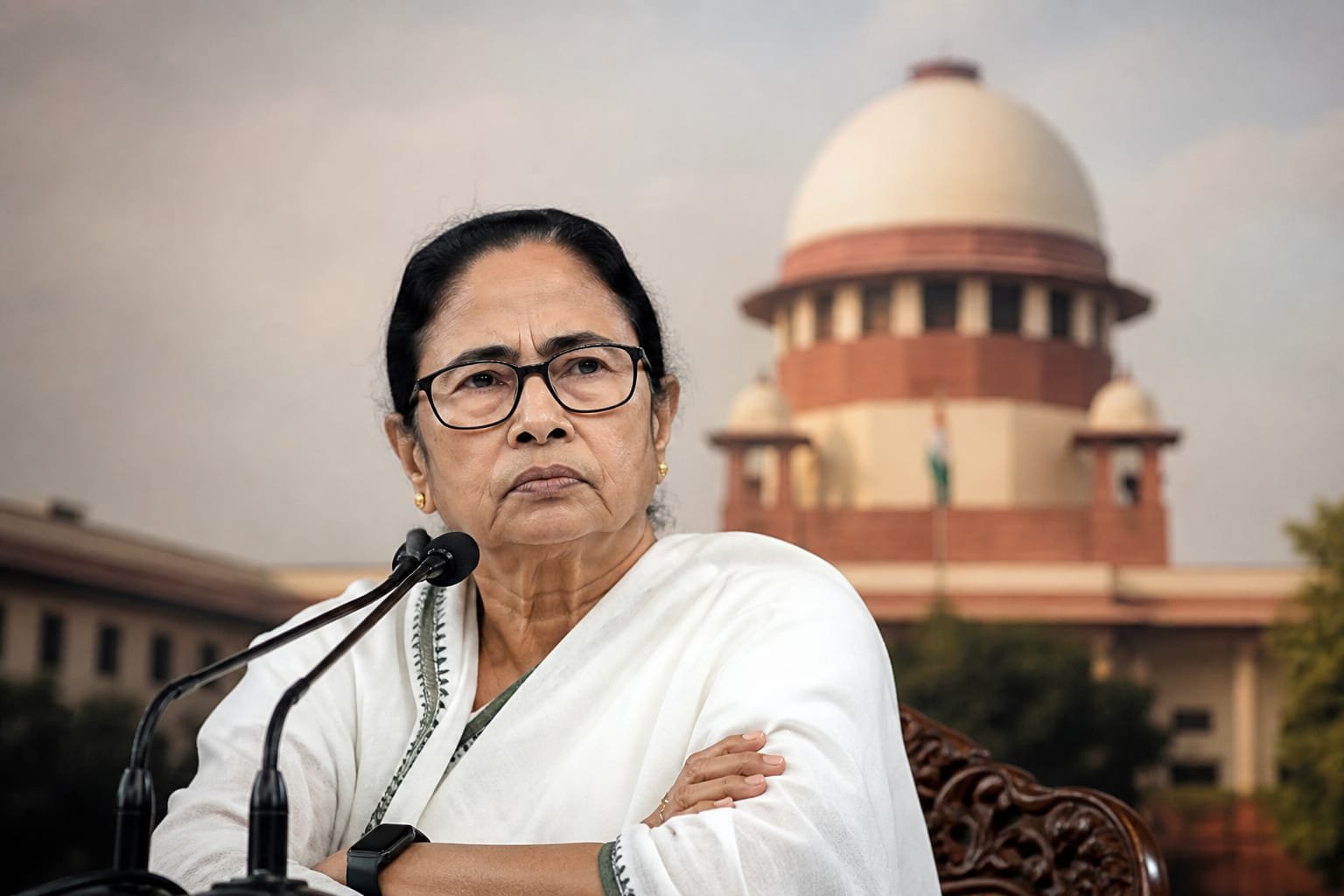
West Bengal’s politics appears to be entering an unprecedented phase of constitutional and political crisis. After the crushing defeat of the Trinamool Congress in the 2026 Assembly elections, Chief Minister Mamata Banerjee refused to accept the election results and clearly stated that she would not resign from the post of Chief Minister. Her statement has triggered massive political turmoil in Bengal.
Speaking at a press conference in Kolkata on Tuesday, Mamata Banerjee adopted an extremely aggressive tone and said, “We have not lost the elections. Around 100 of our seats were stolen. I will neither go to Raj Bhavan nor resign.” She also leveled serious allegations against the Election Commission, calling it the “villain of democracy.”
BJP’s Historic Victory, Power Shift in Bengal After 15 Years
In West Bengal, the Bharatiya Janata Party secured a clear majority for the first time, winning more than 200 seats. This victory is being viewed not merely as an electoral success, but as a major transformation in Bengal’s decades-old political culture.
Politically, the biggest setback for Mamata Banerjee came in the Bhabanipur constituency, where she was defeated by BJP leader and Leader of Opposition Suvendu Adhikari. Bhabanipur had long been considered the strongest bastion of Mamata’s political identity.
“The Mandate Was Stolen” Mamata’s Allegations Deepen Controversy
Mamata Banerjee alleged that large-scale rigging took place during the election process. She claimed that her party agents were prevented from entering several polling booths, CCTV cameras were shut down, and the administrative machinery was misused.
She said that the Trinamool Congress would challenge the results both legally and politically. According to party sources, the TMC may soon approach the Election Commission and the courts.
What Happens Next? What Does the Constitution Say?
Constitutional experts say that if another party has secured a clear majority, the sitting Chief Minister is expected to resign. However, the Constitution nowhere states that a Chief Minister automatically loses office immediately after an electoral defeat. In such a situation, the Governor’s role becomes extremely crucial.
If the Chief Minister refuses to resign, the Governor may ask her to prove her majority on the floor of the Assembly or invite the new majority party to form the government. Political circles are now closely watching the next move from Raj Bhavan.
Is This the End of Mamata Banerjee’s Political Era?
Mamata Banerjee came to power in 2011 by ending the 34-year rule of the Left Front and established herself as Bengal’s most powerful mass leader. However, the 2026 election is being seen as the most difficult phase of her political career. After remaining in power for three consecutive terms, this defeat could also trigger major changes within the Trinamool Congress itself.
Political analysts believe that Mamata Banerjee is now preparing for a “street versus power” battle. This is why, instead of accepting defeat, she has chosen the path of confrontation.
Political Tensions May Rise in Bengal
Reports of tension have emerged from several parts of the state after the election results. Administrative alertness has been increased, and security has been tightened around “Nabanna” in Kolkata as well as Mamata Banerjee’s residence.
The entire episode has brought Bengal to a point where the conflict may become not only political but also constitutional in nature. In the coming days, it will become clear whether Mamata Banerjee takes her battle to the streets and the courts, or ultimately chooses the democratic path of transferring power.