

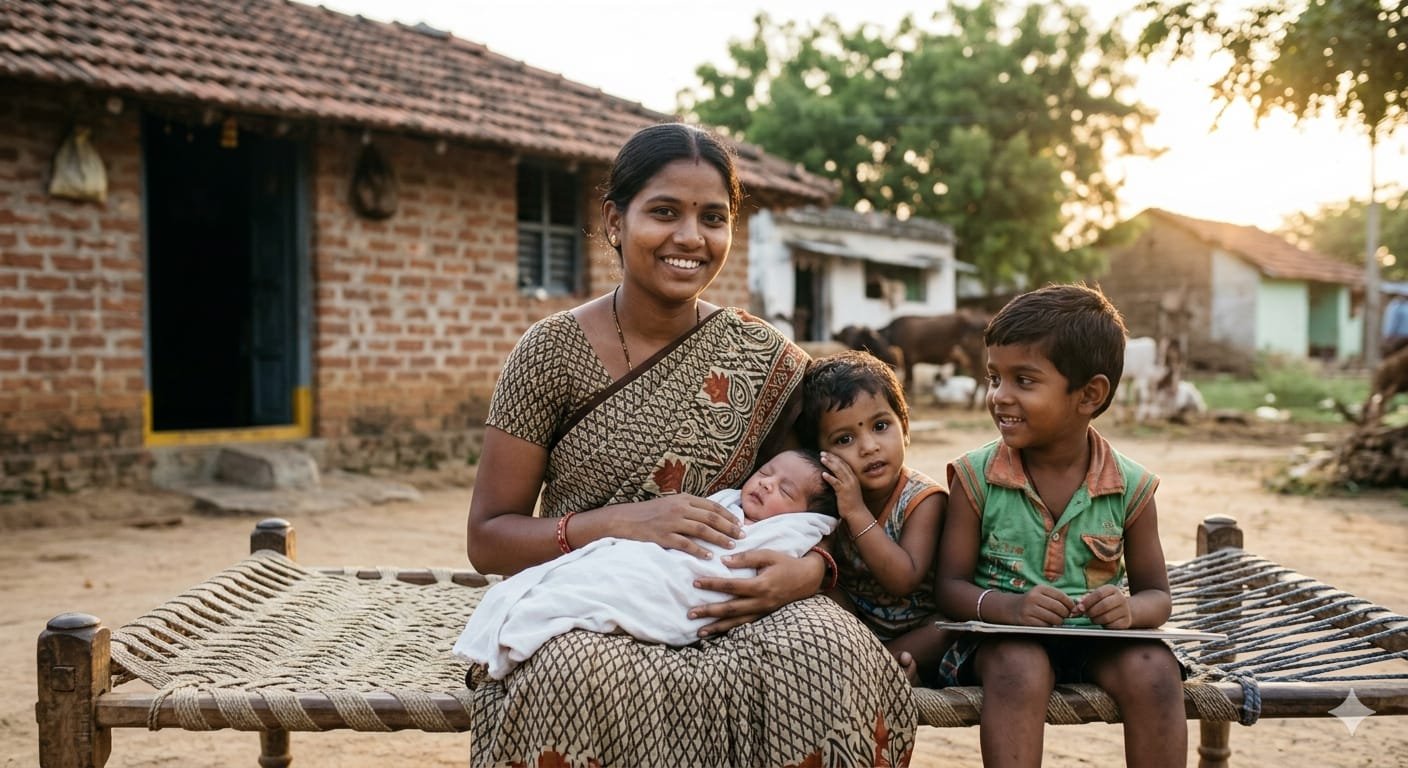
Amid rapidly declining birth rates and shifting demographic balance in South India, Andhra Pradesh Chief Minister N. Chandrababu Naidu has made an announcement that has triggered a fresh political, social, and economic debate across the country. The Chief Minister declared that the state government will provide financial assistance of ₹30,000 for the birth of a third child and ₹40,000 for the birth of a fourth child.
Addressing a public gathering in Narsannapeta of Srikakulam district, Naidu said, “Children are the wealth of the nation, not a burden.” He warned that if population growth in the state continues to decline, it could seriously affect the workforce, economy, and social structure in the coming years.
From Family Planning to “Population Encouragement”: Why Has Naidu Changed His Politics?
The announcement is considered significant because Chandrababu Naidu himself was once a strong supporter of population control and family planning. However, he has now openly stated that times have changed and society must start thinking about increasing birth rates.
He said that rising incomes, urban lifestyles, and changing social priorities have led many families to choose having only one child. Some families consider a second child only if the first child is a girl. Naidu described this trend as a “dangerous social signal” for the future.
“Children Are Wealth”: Blueprint of a New Policy
The Andhra Pradesh government plans to implement the initiative under a campaign titled “Children Are Wealth.” The Chief Minister indicated that this would not remain just a cash incentive scheme, but would also be linked to children’s education, healthcare, nutrition, and maternal welfare services.
According to reports, the government was initially considering providing ₹25,000 for a second child, but later decided to extend the scheme to the third and fourth child. Andhra Pradesh Health Minister Satya Kumar Yadav has also confirmed that the government is now working on a “third child and beyond” policy.
Why Is Declining Population Becoming a Concern?
According to experts, the Total Fertility Rate (TFR) in several South Indian states such as Andhra Pradesh, Tamil Nadu, Kerala, and Karnataka is falling rapidly. A fertility rate of 2.1 is considered necessary to maintain a stable population, but many southern states have already fallen below this level. This means that in the coming decades, the elderly population may rise while the working-age youth population could shrink.
Several developed countries, including Japan and South Korea, are already facing this crisis. In his speech, Naidu said India should avoid repeating the “population decline mistake” made by these countries.
Is There Political Calculation Behind This Too?
Political analysts believe the debate is driven not only by social concerns but also by political calculations. Leaders in South India have long expressed fears that future redistribution of parliamentary seats based on population could reduce the representation of southern states, while northern states continue to witness faster population growth.
As a result, some southern states are now beginning to view declining population as a threat to their political representation and economic share.
However, the announcement has also drawn criticism from opposition parties and social activists. Critics argue that in a time of rising inflation, unemployment, and increasing costs of education and healthcare, offering ₹30,000 or ₹40,000 alone may not realistically encourage people to have more children.
Some experts also said that if the government genuinely wants to increase population growth, it must strengthen women’s safety, employment opportunities, maternity benefits, public schooling, and healthcare services. Cash incentives alone cannot become a long-term solution.
India’s Population Politics at a Turning Point
There was a time when slogans like “Hum Do, Hamare Do” were part of official government policy in India. But now, the situation appears to be reversing in some parts of the country. Andhra Pradesh’s move indicates that in the coming years, India may witness a shift from “population control” politics to “population balance” politics.
For now, Chandrababu Naidu’s announcement is being seen not merely as a government scheme, but as a major signal of India’s changing demographic thinking, economic anxieties, and political strategy.