

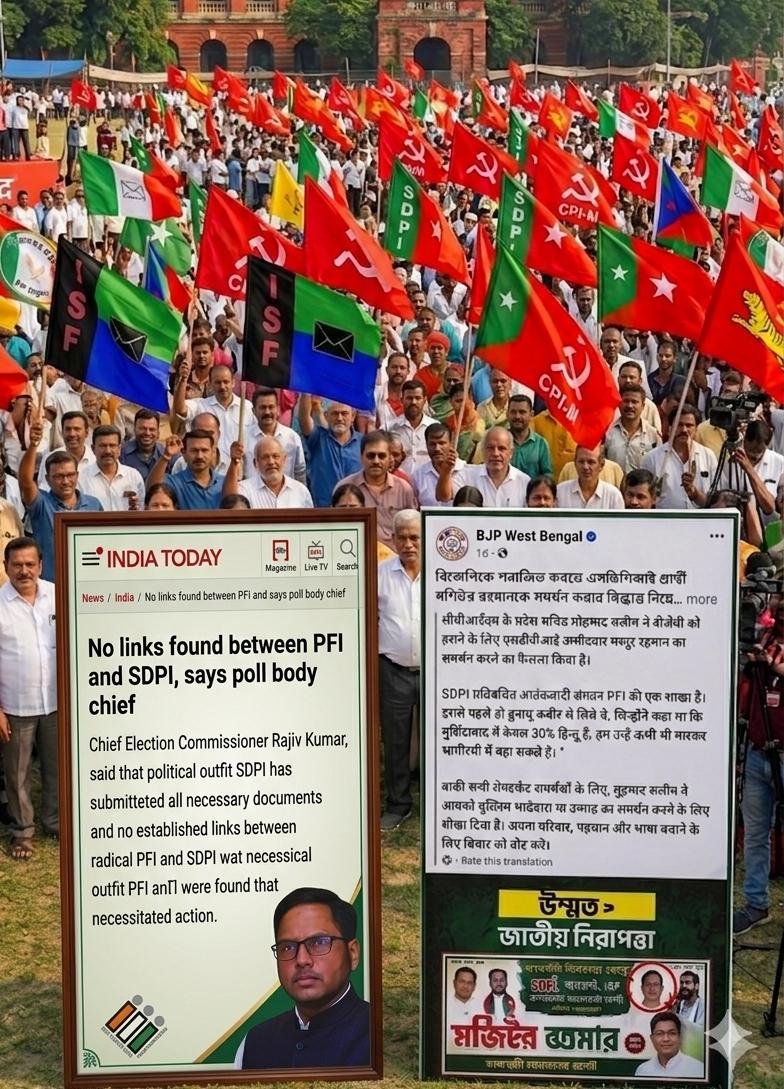
Amid the election atmosphere in West Bengal, a fresh political controversy has emerged over the Social Democratic Party of India (SDPI). Following a social media post by the West Bengal unit of the Bharatiya Janata Party (BJP), allegations and counter-allegations have intensified in state politics. In its official Facebook post, the BJP claimed that Mohammed Salim, state secretary of the Communist Party of India (Marxist) (CPI-M), supported SDPI candidate Mashiur Rahman in order to defeat the BJP. The party also described SDPI as a “branch” of the banned organisation Popular Front of India (PFI).
Responding to the BJP’s remarks, SDPI West Bengal state president Hakikul Islam strongly rejected the allegations, accusing the BJP of “lies, confusion, and politics of fear.” He said the BJP is systematically running a “false, distorted and targeted campaign” against SDPI through social media to create communal polarisation for electoral gains.
Hakikul Islam stated that SDPI is a duly registered and recognised political party under the Election Commission of India, functioning strictly within the framework of the Indian Constitution, democratic values, and legal provisions. He added that the party has consistently worked on issues of social justice, democratic rights, and the welfare of Dalits, backward classes, minorities, and marginalised communities across the country.
Referring specifically to 3 October 2022, he said that then Chief Election Commissioner Rajiv Kumar had clearly stated that no “proven link” existed between SDPI and the banned organisation PFI. He further claimed that this statement was also reported by national media outlet India Today at the time. Despite this, he alleged, the BJP continues to repeat unverified and misleading claims to misguide the public.
The SDPI state president said that the BJP’s politics is not limited to defaming a single party but amounts to an attack on democratic values and constitutional politics. He accused the BJP of attempting to create an atmosphere of fear and hatred in society for electoral advantage.
Hakikul Islam also asserted that SDPI’s activities are fully transparent and operate within the legal framework. He claimed that more than one thousand elected representatives of the party are currently active in public service and democratic responsibilities across various parts of the country.
He appealed to citizens and voters not to fall prey to “false and misleading information” circulating on social media and to make decisions based on facts. He said political differences are natural in a democracy, but maligning a legitimate political party through false accusations goes against democratic traditions.
He also urged the Election Commission to take immediate action against what he described as “misleading and malicious propaganda” being spread by the BJP, stating that efforts to damage the reputation of a recognised political party and mislead voters must be curbed.
Meanwhile, political circles are increasingly discussing SDPI’s association with the Left alliance in West Bengal, which is led by the CPI(M). The alliance reportedly includes various Left parties as well as the Indian Secular Front (ISF). Analysts believe the BJP is targeting this alliance as part of a broader strategy to simultaneously attack Left parties and minority political representation.
In Tamil Nadu, SDPI is associated with an alliance led by the Dravida Munnetra Kazhagam (DMK), which includes CPI(M), Congress, the Indian Union Muslim League (IUML), Viduthalai Chiruthaigal Katchi (VCK), and other parties. This grouping is also considered part of the INDIA bloc. SDPI supporters argue that the BJP is deliberately ignoring political realities where multiple parties have engaged with SDPI in democratic and electoral arrangements.
A significant aspect of the debate is also the allegation of a “double political standard” against the BJP. Critics argue that while the BJP questions opposition parties over ties with SDPI, its own allies in different states have previously engaged in electoral or political understandings with the party.
In Tamil Nadu, the All India Anna Dravida Munnetra Kazhagam (AIADMK) has previously had electoral understandings with SDPI, while currently it shares political alignment with the BJP. Similarly, in Karnataka, the Janata Dal (Secular) has had political coordination with SDPI and is now part of the National Democratic Alliance (NDA). Political circles have also discussed instances of cooperation between SDPI and parties like the Janata Dal (United) and the Lok Janshakti Party in Kerala and Bengal.
Political observers note that alliances in Indian politics shift over time, and nearly all major parties have, at different points, engaged with various social and political groups across states. In this context, the controversy surrounding SDPI has expanded beyond a single party issue, evolving into a broader debate on alliance politics, communal polarisation, and democratic legitimacy at the national level.
The BJP’s social media post also referenced a controversial past statement by Trinamool Congress MLA Humayun Kabir. The BJP accused opposition parties of “appeasement politics” and urged voters from the Left camp to carefully consider their vote in the name of protecting identity, language, and family.
On the other hand, SDPI and its supporters describe the entire controversy as part of the BJP’s “polarisation-based electoral strategy,” alleging that the party seeks to label political opponents as anti-national or suspicious to gain electoral advantage.
Political analysts believe that during the ongoing election phase in West Bengal, minority politics, the Left alliance, the BJP’s ideological electoral strategy, and the role of smaller regional parties are likely to become increasingly significant. In this context, the controversy surrounding SDPI is not merely a matter of social media exchanges but reflects deeper shifts in alliance politics and electoral polarisation in both Bengal and national politics.