

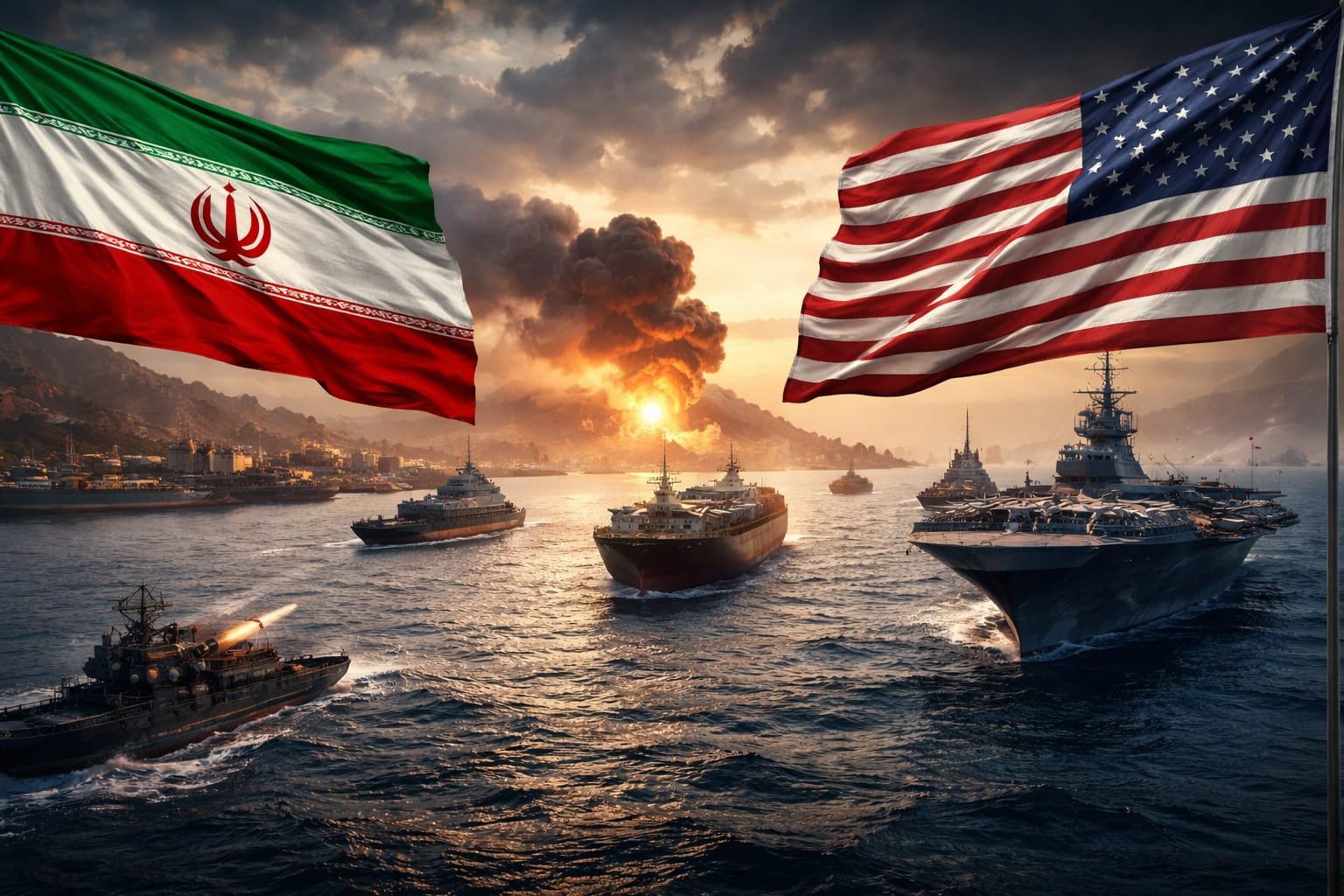
Geopolitical tensions in the Middle East continue to intensify. The ongoing confrontation between Iran and the United States has moved beyond mere diplomatic rhetoric and is now taking the shape of direct military warnings and challenges over control of key maritime routes. At the center of this dispute lies the Strait of Hormuz, widely regarded as the lifeline of global oil supply.
Recent developments, including around 20 significant statements by Iran’s top leadership, military officials, and government institutions, संकेत that the situation is rapidly becoming more serious.
Iran’s President Masoud Pezeshkian rejected the stance of U.S. President Donald Trump, stating that the United States has no justification to deprive Iran of its nuclear rights. He made it clear that Iran will not back down from its rights.
In the same vein, Iran’s Foreign Ministry stated that enriched uranium is a symbol of national dignity and sovereignty for the country, and it will neither be handed over to any other nation nor transferred elsewhere under any circumstances.
On the diplomatic front, a clear deadlock is visible. Deputy Foreign Minister Saeed Khatibzadeh said that no date has been set for the next round of talks with the United States, as Washington remains rigid on excessive and unilateral demands. He emphasized that dialogue cannot move forward until both sides agree on a common framework.
He also accused the U.S. of being unreliable, stating that its statements are often contradictory. Meanwhile, Mohammad-Baqer Qalibaf noted that while there has been agreement on some issues, major differences still persist on several key matters.
On the maritime front, tensions have escalated further. Iran has accused the United States of imposing a naval blockade on its ports, calling it a violation of international law. In response, the Islamic Revolutionary Guard Corps issued a stern warning, stating that all vessels passing through the Strait of Hormuz must comply strictly with its naval command directives.
The organization further warned that ships failing to follow these instructions would be considered as cooperating with the enemy. It also announced that if the U.S. blockade is not lifted, the Strait of Hormuz would be closed, with reports later suggesting a possible temporary closure.
Iran justified its stance by asserting that if the waterway is used for military aggression against it, it has the right to block it.
Iran’s First Vice President Mohammad Reza Aref adopted a hardline stance, declaring that full control over the Strait of Hormuz rests with Iran. He stated that if rights are not secured through negotiations, they would be achieved on the battlefield.
He reiterated that Iran would not compromise on its sovereignty in the region. In the same context, the Iranian military stated that the Strait of Hormuz would remain entirely under Iran’s control and would only be reopened unconditionally if the United States guarantees complete maritime freedom for Iran.
Military rhetoric continues to intensify. Defense Ministry spokesperson Reza Talaei stated that the conflict with the United States is not over, and any deception in diplomacy would be met with a strong response. He added that reopening the Strait for civilian vessels would also depend on certain conditions, including ceasefires in regional conflicts.
The Iranian Army Chief warned the United States to permanently abandon any idea of ground military action. Meanwhile, a senior national security official stated that the U.S. had already been warned and would now have to face the consequences of its actions.
Iran’s Deputy Foreign Minister termed the U.S. naval blockade illegal, saying it threatens not just Iran but the stability of the entire region, and that aggressive policies cannot yield positive outcomes.
Parliament member Ismail Kosari warned that any closure of the Strait of Hormuz or the Red Sea would have far-reaching consequences, potentially pushing several countries into economic crisis.
Amid these developments, India has also been affected. Following reports of firing on two Indian-flagged vessels in the Strait of Hormuz, the Indian government summoned Iran’s ambassador, signaling that the crisis is now having global repercussions.
According to Iran’s Tasnim News Agency, the next round of talks has yet to be scheduled due to the U.S. blockade and increasing demands, weakening the prospects of a diplomatic resolution.
The escalating confrontation between Iran and the United States is now taking a serious turn. The ongoing tension over control of the Strait of Hormuz poses a significant threat to global energy supply, trade, and security.
If a balanced solution is not found soon, this crisis could escalate into a major regional or even global conflict, with consequences that the entire world may have to bear.