

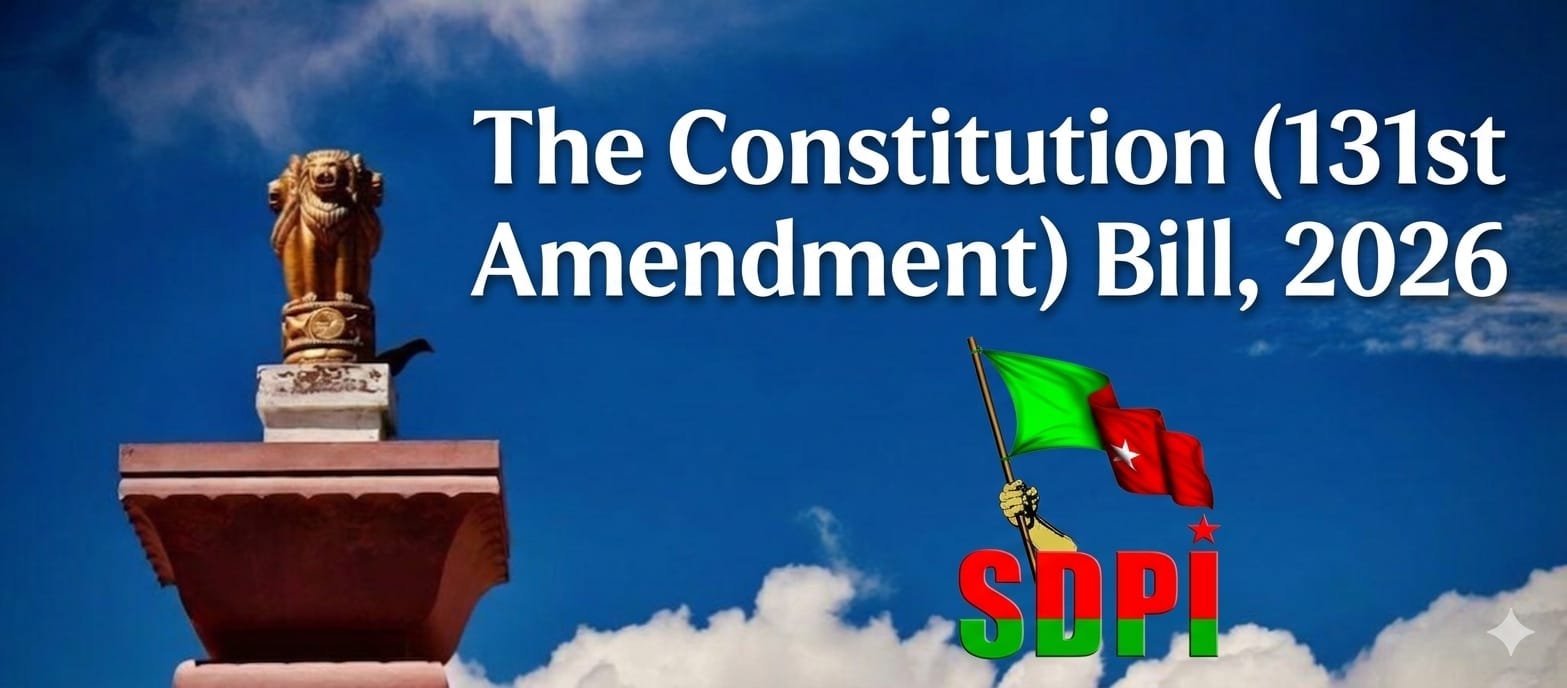
The defeat of the Constitution (One Hundred and Thirty-First Amendment) Bill, 2026 in the Lok Sabha has been described by the Social Democratic Party of India as a significant turning point for Indian democracy. The party’s National General Secretary, Muhammad Ashraf, termed it a decisive victory for federalism, social justice, and constitutional balance.
In his detailed statement, Ashraf said that SDPI has been a strong supporter of 33 percent reservation for women, but linking this crucial issue with broader electoral restructuring—such as delimitation and increasing the number of Lok Sabha seats to 850—raises serious concerns. According to him, this move not only confuses policy priorities but also casts doubts on the fairness of the democratic process.
He alleged that the timing of the bill was not coincidental, but appeared to be part of a calculated strategy to influence political equations ahead of upcoming elections. Ashraf stated that genuine democratic reforms require transparency, broad consensus, and guaranteed social representation—elements that were clearly missing in this proposal.
Expressing concern over the provisions of the bill, he said that redrawing constituencies based on outdated data from the 2011 Census, and linking it with women’s reservation, was not only hasty but also weakens the concept of social justice. He emphasized that without a comprehensive caste census, such decisions could adversely affect the political empowerment of women from Other Backward Classes (OBC), Scheduled Castes (SC), Scheduled Tribes (ST), and religious minorities.
SDPI also highlighted that the proposed delimitation process could have disrupted India’s federal structure. States that have been relatively successful in controlling population growth could have been disadvantaged compared to those with higher population growth. According to the party, such an imbalance would not only distort representation among states but could also have long-term implications for national unity.
Ashraf further pointed out the clear lack of meaningful and wide-ranging consultation with state governments, political parties, and other stakeholders before introducing such an important constitutional amendment. He stressed that reforms based on consensus are the only ones that are sustainable and effective in a democracy.
The party reiterated that women’s reservation should be implemented as an independent and primary reform, rather than being used as a tool for broader electoral restructuring. SDPI believes that true gender justice can only be achieved when policies are inclusive, transparent, and centered on the interests of marginalized communities.
SDPI appealed to the government to ensure that any future constitutional changes uphold the basic structure of the Constitution, protect federal values, and follow a transparent and inclusive process of consultation. The party also made it clear that it will continue its struggle for the rights of women and all marginalized communities.
This development is not just the defeat of a bill, but also a sign that democratic institutions and public opinion in India still have the capacity to stand against measures that challenge social justice and federal balance.