

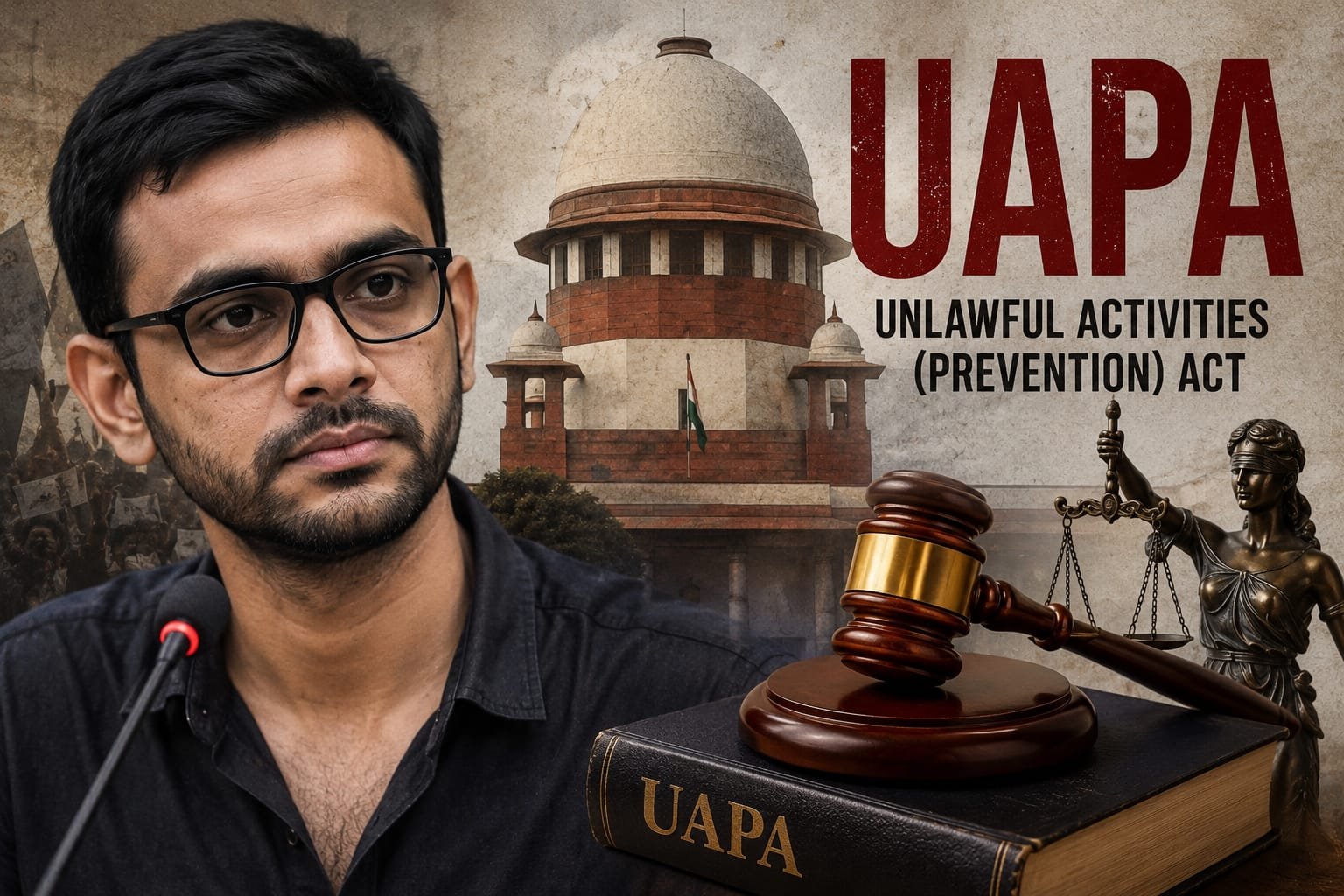
The Supreme Court’s latest remarks on bail in UAPA cases have triggered a fresh debate over India’s criminal justice system and constitutional rights. On Monday, the apex court observed that “bail is the rule and jail is the exception,” adding that this principle applies equally even under stringent laws like the Unlawful Activities (Prevention) Act (UAPA).
A bench of Justice B. V. Nagarathna and Justice Ujjal Bhuyan also indicated during the hearing that the principles laid down by larger benches may not have been properly followed in the January 2026 decision denying bail to Umar Khalid and Sharjeel Imam. The court emphasized that smaller benches cannot deviate from judgments delivered by larger benches.
Reference to the “K.A. Najeeb” Judgment
The Supreme Court referred to the landmark 2021 judgment in “Union of India vs K.A. Najeeb”, stating that if a trial cannot be completed within a reasonable time, courts cannot ignore the constitutional right to personal liberty and speedy trial guaranteed under Article 21 of the Constitution.
The court said that even the stringent provisions of UAPA cannot completely override constitutional protections. According to the bench, decisions of larger benches are binding on smaller benches, and adherence to them is part of judicial discipline.
In Which Case Did the Court Make These Remarks?
The observations came while granting bail to Syed Iftikhar Andrabi, an accused in an alleged “narco-terror” case from Jammu and Kashmir. During the hearing, the court remarked that keeping someone in prison for years without trial could violate the basic principles of justice.
Why Was Umar Khalid Denied Bail Earlier?
In January 2026, another bench of the Supreme Court had rejected the bail pleas of Umar Khalid and Sharjeel Imam. At the time, the court had observed that the role attributed to both accused persons was “qualitatively different” and more serious than that of other co-accused.
The court had held that the prosecution possessed prima facie material against them, thereby attracting Section 43D(5) of the UAPA. This provision makes the grant of bail in UAPA cases extremely difficult. However, five other co-accused in the same case had been granted relief.
Long Incarceration vs National Security
Legal experts are viewing the Supreme Court’s latest remarks as highly significant. According to them, the observations indicate growing judicial concern over prolonged pre-trial detention in UAPA cases.
While courts have consistently stressed the importance of national security and stringent anti-terror laws, the recent remarks also underline the need to protect personal liberty and the constitutional right to speedy justice.
Umar Khalid Has Been in Jail for Over Five Years
Umar Khalid has been in jail since September 2020 in the Delhi riots “larger conspiracy” case. The trial in the matter has still not fully commenced.
Delhi Police alleges that a planned conspiracy was carried out under the guise of anti-CAA-NRC protests. The accused, however, have consistently maintained that the case is an attempt to criminalize political dissent.
What Impact Could These Remarks Have?
Legal observers believe that the Supreme Court’s comments could influence future bail hearings in UAPA cases, especially where accused persons have remained incarcerated for long periods without trial.
For now, the court’s remarks are being seen not merely as observations in a single case, but as a potentially important turning point in the evolving jurisprudence surrounding UAPA and constitutional liberties in India.