
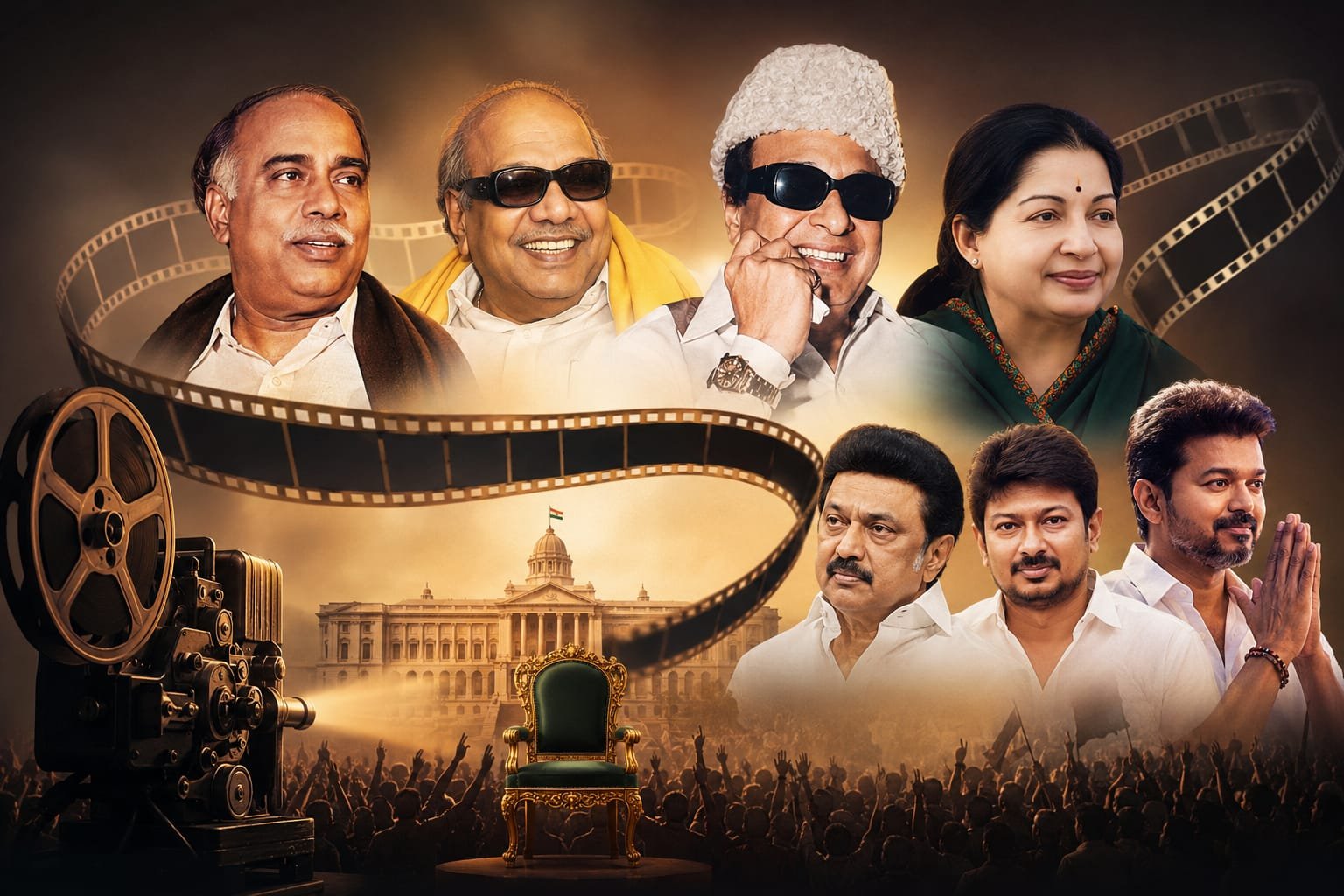
If there is one Indian state that has lived the relationship between cinema and political power more deeply than any other, it is Tamil Nadu. Here, cinema was never just entertainment on the screen; it became the most influential platform for social movements, linguistic identity, anti-caste politics, public emotions, and electoral struggles. That is why Tamil society does not see the rise of actor Vijay and his party Tamilaga Vettri Kazhagam (TVK) as a “new phenomenon,” but rather as the next chapter in a long political and cultural history.
For nearly seven decades, films and politics in Tamil Nadu have blended so deeply that the boundaries between the two often appear blurred. The state’s two most influential political forces — Dravida Munnetra Kazhagam (DMK) and All India Anna Dravida Munnetra Kazhagam (AIADMK) — were both directly shaped by the film industry and the Dravidian cultural movement. Actors, screenplay writers, dialogue writers, dramatists, and film propagandists have repeatedly risen to become chief ministers.
The Dravidian movement turned cinema into a political weapon
The organized political use of cinema in Tamil Nadu began with the Dravidian movement. Its ideological roots lay in E.V. Ramasamy “Periyar’s” Self-Respect Movement, which fought against Brahminical dominance, caste hierarchy, and social inequality.
Dravidian leaders understood early on that speeches and newspapers alone would not be enough to reach the masses. At a time when theatre and cinema were rapidly gaining popularity among Tamil audiences, films became a vehicle for ideological messaging. This was the turning point that gave Tamil Nadu’s politics a distinct identity unlike any other Indian state.
Annadurai : The man who changed the language of politics
C.N. Annadurai, founder of the Dravida Munnetra Kazhagam (DMK), was not just a politician. He was also a journalist, writer, dramatist, and screenplay writer. Through films and theatre, he carried Dravidian ideology directly to the people.
Annadurai replaced the Sanskritized, elite form of Tamil used in cinema with the language spoken by ordinary people. This shift was not merely linguistic — it was deeply political. For the first time, poor, backward, and non-Brahmin communities felt that cinema and politics were speaking in their language.
His stories and dialogues carried strong themes of social justice, anti-caste politics, self-respect, and Tamil identity. This style later became one of the greatest strengths of the DMK.
Karunanidhi : The screenwriter whose dialogues became political slogans
Former Chief Minister M. Karunanidhi is widely regarded as the most influential screenwriter in Tamil political history. He wrote film dialogues that openly reflected politics, social justice, and ideological struggle.
The 1952 film “Parasakthi” is considered a milestone in both Tamil cinema and politics. The film sharply criticized religious hypocrisy, social inequality, and Brahminical dominance. It generated enormous controversy at the time, but that very controversy carried it into villages across Tamil Nadu.
Karunanidhi’s language was so powerful that his cinematic dialogues later became political slogans and campaign rhetoric. He eventually served five terms as Chief Minister and emerged as one of the defining faces of Dravidian politics.
MGR : The screen hero who became the people’s leader
M.G. Ramachandran, popularly known as MGR, transformed Tamil politics completely. He was not merely a superstar — he became a symbol of public emotion and aspiration.
In films, he was portrayed as the protector of the poor, an honest man, and a hero who fought injustice. Audiences began to associate this screen image with his real-life personality. That became his greatest political asset.
MGR initially belonged to the Dravida Munnetra Kazhagam (DMK) and was one of the party’s most popular campaigners. But after differences with Karunanidhi, he founded the All India Anna Dravida Munnetra Kazhagam (AIADMK).
In 1977, he became Chief Minister and remained in power until his death. He proved that in Tamil Nadu, cinematic popularity could be directly converted into electoral power.
Jayalalithaa : From actress to “Amma”
Former Chief Minister J. Jayalalithaa was one of Tamil cinema’s most celebrated actresses. She acted in several blockbuster films alongside MGR, and the pair enjoyed extraordinary popularity among Tamil audiences.
After MGR’s death, a fierce succession battle erupted within the AIADMK, but Jayalalithaa gradually established herself as the party’s strongest leader.
She not only captured power but also built an emotional political identity as “Amma” (Mother). Through welfare schemes, subsidies, and mass outreach programs, she cultivated an almost charismatic image among the poor and marginalized.
Stalin and Udhayanidhi : A new blend of organization and cinema
Current Chief Minister M.K. Stalin acted in films and television dramas during his youth, but his primary identity remained rooted in organizational politics. He rose through the DMK youth wing, became Mayor of Chennai, then minister, deputy chief minister, and eventually chief minister.
On the other hand, Udhayanidhi Stalin gained popularity as an actor and producer. He remained closely connected to influential production networks within the Tamil film industry before actively entering politics.
Tamil political circles frequently discuss the political and personal rivalry between actor Vijay and Udhayanidhi Stalin. Both are believed to hold strong influence among urban youth and audiences shaped by film culture.
Vijay : The new superstar model of the digital era
Actor Vijay’s political rise is widely seen as the modern continuation of the tradition established during the eras of Annadurai, Karunanidhi, and MGR.
Vijay’s popularity extended far beyond cinema. His fan organizations had long been active in social work, relief campaigns, and political signaling. In 2024, he formally entered politics, declaring that politics for him was a means of “public service.”
In the 2026 elections, Tamilaga Vettri Kazhagam (TVK) delivered a remarkable performance. The party’s strong showing in Chennai and several urban constituencies signaled the possible emergence of a third major force in Tamil politics.
Political observers argue that Vijay has merged MGR’s “mass superstar model” with social media outreach, digital campaigning, youth voters, and modern political branding.
Not every superstar succeeded
Tamil Nadu’s history also shows that cinematic popularity alone does not guarantee political success.
Kamal Haasan launched his own party but failed to achieve the kind of success enjoyed by MGR or Jayalalithaa. Rajinikanth gave political signals for years but ultimately did not fully enter active politics.
Vijayakanth did emerge as a major political figure for a time, and his party Desiya Murpokku Dravida Kazhagam (DMDK) even became the state’s principal opposition force. However, his political influence later declined sharply.
This demonstrates that lasting political success in Tamil Nadu requires more than stardom — it demands organization, ideological grounding, social alliances, and the right political timing.
Cinema : The political language of Tamil society
In Tamil Nadu, cinema has never been merely an entertainment industry. Film dialogues, songs, posters, fan clubs, and actors have remained central to political consciousness for decades.
Fan organizations often transform into election machinery. At times, cinematic dialogues prove more influential than political speeches themselves. That is why, in Tamil politics, a “star” is not viewed only as an entertainer but also as a potential political force.
Vijay’s rise may appear new to national politics, but for Tamil Nadu it is simply the latest chapter in a long tradition — a tradition in which faces emerging from the silver screen have profoundly shaped public emotions, social movements, and the politics of power.
TamilNadu #TamilNaduPolitics #Vijay #TVK #TamilagaVettriKazhagam #DMK #AIADMK #MGR #Jayalalithaa #Karunanidhi #Annadurai #MKStalin #UdhayanidhiStalin #DravidianPolitics #DravidianMovement #TamilCinema #CinemaAndPolitics #SouthIndiaPolitics #FilmToPolitics #InsaafTimes