

Insaaf Times Desk
The Election Commission has officially set the stage for the “Mother of All Elections” — the Bihar polls. All political parties are leaving no stone unturned to capture the attention of voters. Political meetings are at their peak; while some parties are engaged in seat-sharing negotiations, others are strategizing manifesto promises and maneuvering social equations to woo the electorate.
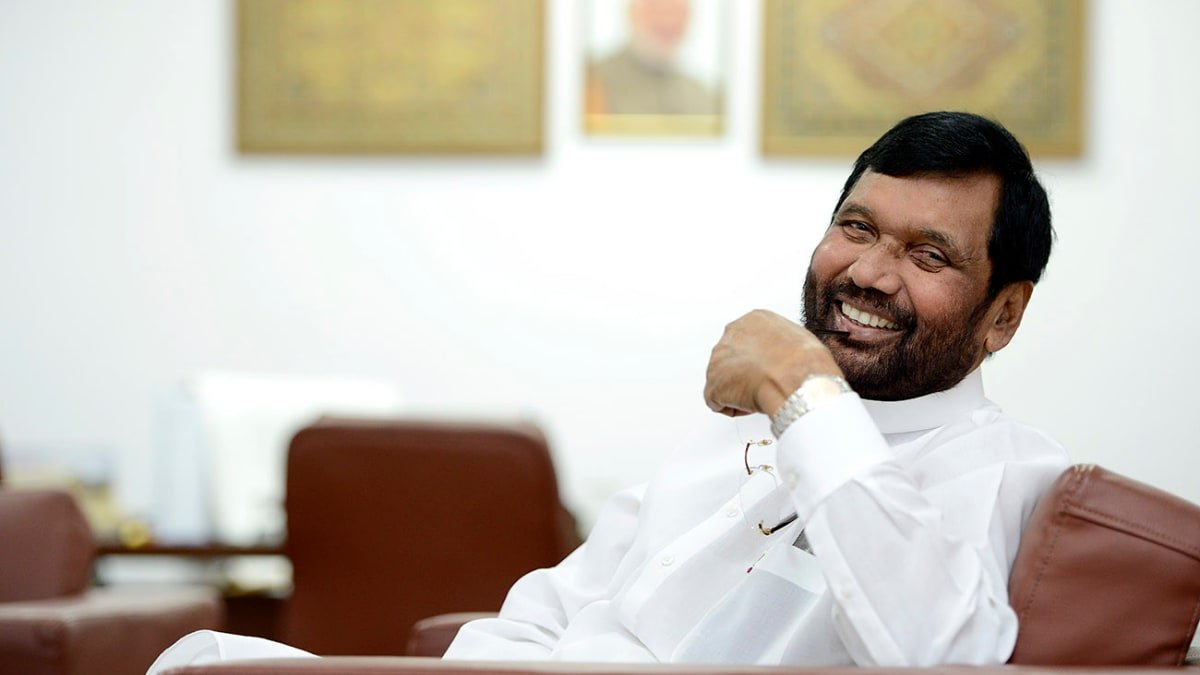
Amid this electoral buzz, it is essential to remember one of Bihar’s most prominent political figures — Ram Vilas Paswan, who championed the slogan “Bihar First, Bihari First.” Paswan’s political foresight was unparalleled; he could sense the winds of change and align his moves accordingly, earning him the reputation of being the “weatherman of Indian politics.”
Born on 5 July 1946 in a Dalit family in Shahrbani village, Khagaria district, Bihar, Paswan grew up at a time when the Dalit community faced severe social discrimination and marginalization. Little did anyone know that this boy from a marginalized community would go on to become an MLA, an 11-time Member of Parliament, and a central minister in the cabinets of six different Prime Ministers.
Education and the Journey from DSP to Politics
Paswan’s family understood the value of education and ensured he pursued it despite challenges. His early schooling took place in the village, followed by higher education at Kosi College and Patna University, where he earned an LLB and a Master’s degree. Known for his intelligence and hard work from a young age, Paswan’s efforts bore fruit in 1969 when he was selected for the position of Deputy Superintendent of Police (DSP).
During that period, Bihar was witnessing mid-term elections, and the United Socialist Party offered Paswan a ticket, placing him at a crossroads. A friend famously asked him, “Do you want to be a government servant or a leader?” Paswan chose leadership, resigned from his DSP post, contested the election, and won his first term as an MLA, marking the beginning of his political journey.
JP Movement and the Emergency
As an MLA, Paswan grew close to socialist leader Ram Sajiwan and actively participated in the Patna student movement, which Jayaprakash Narayan turned into the “Total Revolution.” Paswan stood shoulder to shoulder with JP, playing an active role in the movement.
The movement’s impact reached Delhi, creating challenges for Indira Gandhi’s government, which eventually declared the Emergency, arresting opposition leaders, including Paswan.
Record-Breaking Victory and Guinness World Record
After the Emergency ended, the 1977 Lok Sabha elections were announced. In opposition to Indira Gandhi, major leaders formed the Janata Party and contested in unity. Paswan was fielded from Hajipur Lok Sabha constituency, a contest that proved to be a turning point in his life. He defeated his closest rival by a record margin of approximately 1.25 lakh votes.
This victory was not only unprecedented in India but also one of the largest winning margins in any election worldwide, earning him a place in the Guinness Book of World Records.
Paswan continued to dominate Hajipur, winning every Lok Sabha election from 1977 to 2014, except 1984 and 2009. In the 1989 election, he broke his own record, winning by more than 5 lakh votes, setting yet another world record. He then served as the Minister of Labour and Welfare in the V.P. Singh cabinet and went on to serve under five more Prime Ministers, including Narendra Modi.
Dalit Sena and Social Legacy
Throughout his political career, Paswan remained committed to the rights of the marginalized, oppressed, and Dalit communities. In 1983, he founded the Dalit Sena, aimed at championing Dalit interests and amplifying the voice of society’s lowest strata. He often recited lines from Ram Manohar Lohia’s poetry, emphasizing equality in education:
“The British have left, English too shall go…
Whether the son of the President or a peon,
Whether the son of Birla or the poor—education must be equal for all.”
Paswan played a crucial role in implementing the SC/ST Act and securing reservations, earning him the title of a Dalit messiah. As a central minister, he worked to deliver essential ration through the Public Distribution System and advocated for reservation in the judiciary, furthering Dalit empowerment.
Political Journey and Legacy
Paswan’s political trajectory was extensive. He was associated with the Janata Party (1977), Janata Party (Secular), Lok Dal, and Janata Dal, and briefly joined the JD(U) in 1999. On 28 November 2000, he left JD(U) to form his own Lok Janshakti Party, strengthening the voice of Dalits and backward communities.
He allied with both NDA and UPA at different times, often playing the role of a kingmaker. His deep understanding of coalition politics earned him the moniker of India’s “political weatherman,” as he retained his ministerial positions under six different Prime Ministers.
Paswan was elected to the Rajya Sabha in 2014 and 2019. On 8 October 2020, he passed away while serving as the Minister of Consumer Affairs, Food, and Public Distribution under the Modi government. Until his last breath, Paswan maintained an active presence in both politics and governance, leaving an indelible mark on Indian political history.