

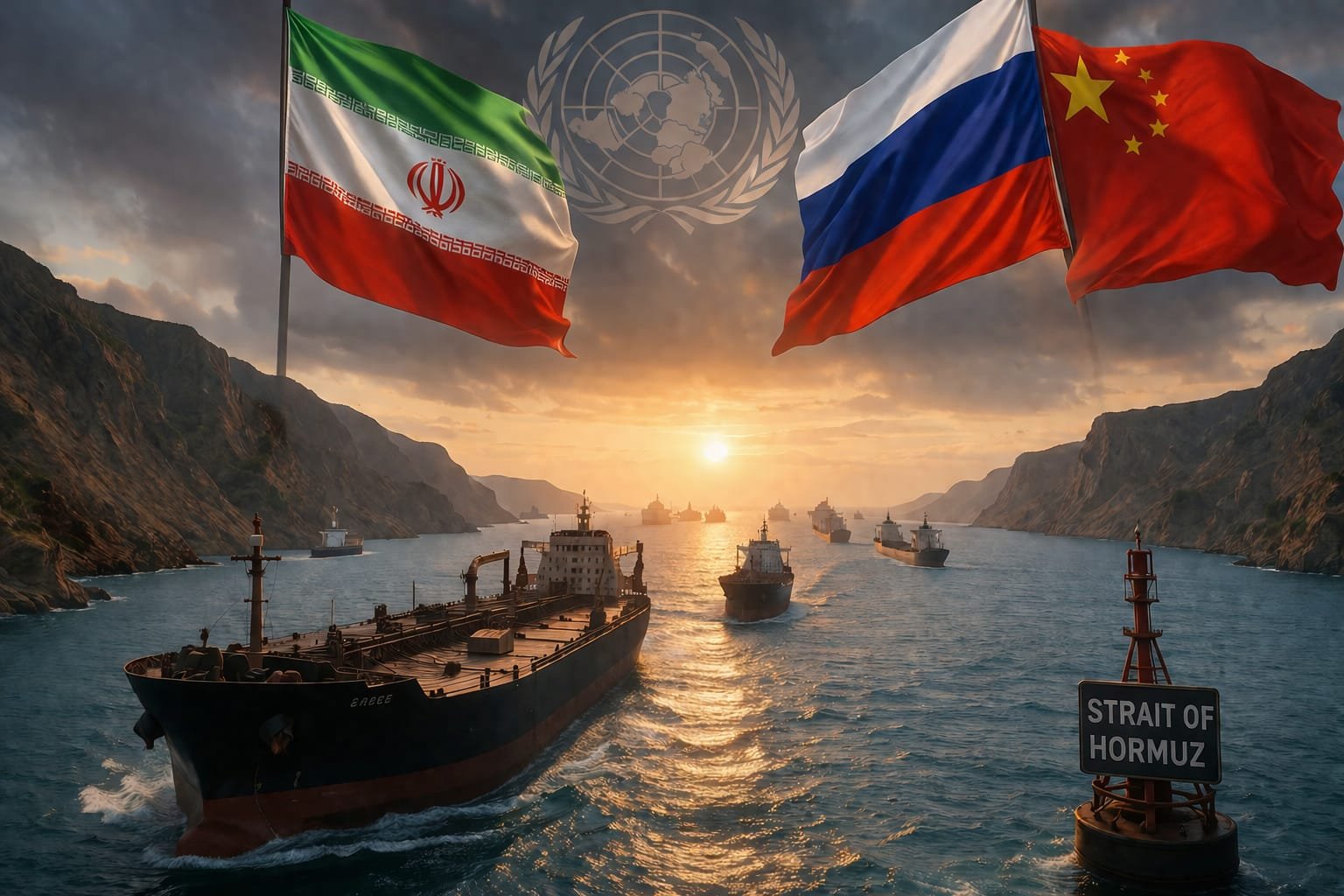
A proposal to reopen the Strait of Hormuz in the United Nations Security Council (UNSC) has failed. Russia and China exercised their veto power, dashing the last diplomatic hopes of the United States and its allies, while global tensions continue to rise.
Background of the Hormuz Crisis
The Strait of Hormuz is one of the world’s most critical maritime routes, accounting for nearly 20% of global oil and gas trade. Any disruption in this passage has immediate repercussions on international energy markets.
Following military actions by the United States and Israel against Iran in February 2026, Iran began restricting the movement of ships through the strait. This not only affected the Middle East but also placed significant pressure on global energy markets, sending oil prices to record highs and rendering commercial shipping unsafe.
The UNSC Proposal
Bahrain presented a resolution in the UNSC to ensure the safe passage of ships through the Strait of Hormuz and reduce escalating tensions. The resolution aimed to:
Ensure the security of maritime passage
Promote international maritime safety
Prevent the outbreak of conflict in the tense situation
The proposal underwent multiple revisions, as permanent members like Russia and China refused to endorse any language involving the use of force. The final draft emphasized defensive cooperation and ship safety, without authorizing any direct military action.
Voting and the Veto
The vote on the resolution took place on April 7, 2026:
11 member countries supported the resolution
2 permanent members (Russia and China) vetoed it
2 members abstained
Under UNSC rules, if a permanent member vetoes a resolution, it cannot pass, regardless of majority support.
Russia and China’s Argument
Russia and China argued that the resolution could promote potential military action. They emphasized that the crisis should be resolved through diplomatic negotiations and a ceasefire, rather than escalation.
U.S. and Allies’ Position
The United States and its allies warned that the closure of the strait posed a serious threat to global energy supply. They urged Iran to immediately reopen the Strait of Hormuz to allow the free flow of international trade.
U.S.–Iran Tensions
Iran’s move to restrict the strait has heightened tensions between Tehran and Washington. U.S. warnings indicated that critical Iranian infrastructure could become targets if safe passage was not ensured promptly. Iran, meanwhile, stated that it retains full control over the Strait of Hormuz and will enforce its conditions. Missiles and retaliatory strikes between Israel and Iran continue, further escalating the crisis.
Global Impact
Oil prices surged sharply
Supply of fertilizers and food was disrupted
Insurance premiums for commercial ships increased
Experts note that this is not merely a regional issue but a crisis affecting global energy, food, and financial markets.
Future Prospects
The UNSC veto highlights deep divisions in global power dynamics. Analysts say diplomatic efforts must be intensified; otherwise, the instability of the Strait of Hormuz could severely impact global oil and gas supply and economic stability.
The Strait of Hormuz remains partially closed. Following the UNSC failure, Russia and China have demonstrated their diplomatic strength and global positioning, while the effects on international oil trade, shipping, and economic markets are clearly evident.