

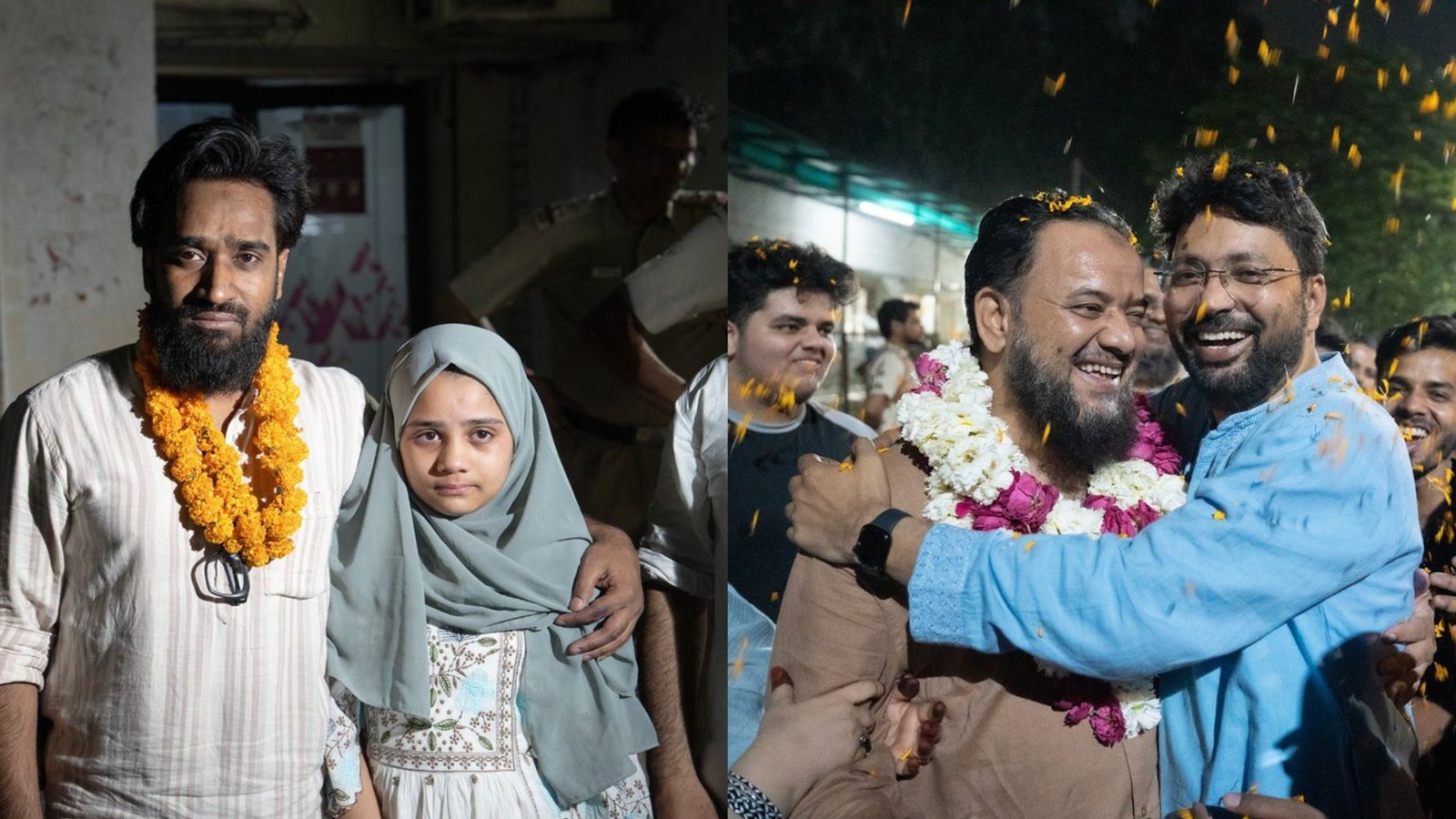
New Delhi: Human rights defenders and anti-Citizenship Amendment Act (CAA) activists Khalid Saifi and Tasleem Ahmed walked out of Tihar Jail on Monday night after spending over six years in custody, following the Supreme Court granting them six months’ interim bail last Friday in the 2020 Delhi riots larger conspiracy case registered under the Unlawful Activities (Prevention) Act (UAPA).
“Process is the punishment,” Saifi said after his release. “The Supreme Court on May 22 granted interim bail to Tasleem Ahmed and Abdul Khalid Saifi in the 2020 Delhi riots conspiracy case, while simultaneously referring a major legal question about bail rights under the UAPA to a larger bench of the court,” The bail order read.
The bail was granted by a division bench of Justice Aravind Kumar and Justice Prasanna B. Varale and granted leave before passing the interim bail order.
Senior Advocate Rebecca John, appearing for the appellants along with advocates Mehmood Pracha and Rajat Kumar said during the hearing “That both men had spent over six years in jail without the trial concluding, and invoked the Supreme Court’s own earlier ruling in the case of Gulfisha Fatima, in which bail had been granted to five co-accused. The prolonged incarceration without any prospect of the trial ending soon violated their fundamental right to personal liberty guaranteed under Article 21 of the Constitution.”
On the other hand, Additional Solicitor General S.V. Raju, appearing for the State, said there appeared to be a divergence in the way different benches of the Supreme Court were interpreting and applying the three-judge bench ruling in Union of India v. K.A. Najeeb, a landmark 2021 judgment dealing with the power of courts to grant bail under special laws such as the UAPA. He urged the bench to refer the matter to an appropriate larger bench to settle the legal position conclusively.
The earlier Gulfisha Fatima bail judgment had correctly distinguished between the roles of different accused persons while deciding their bail pleas and had appropriately relied on the judgments in Kartar Singh v. State of Punjab and Shaheen Welfare Association v. Union of India,”Raju further said.
The bench heard extensive arguments from both sides on the interplay between the right to personal liberty, the delay in trial, and the strict restrictions on bail under Section 43D(5) of the UAPA, which says that no person shall be granted bail for a UAPA offence if the court believes there are reasonable grounds to think the accusation against that person is prima facie true.
What the Court Said in Its Order
The court said in its order that “both appellants had undergone substantial incarceration” since 2020, that the trial was not likely to conclude immediately, and that the two men could not be made to suffer continued incarceration merely because an important question of law has arisen for authoritative settlement.”
The bench made clear in its order that the K.A. Najeeb ruling “is neither a charter for indefinite incarceration under the cover of Section 43D(5), nor a mathematical command that the mere passage of time, divorced from all surrounding circumstances, must automatically result in bail.” It said the true question was not whether Article 21 survives Section 43D(5) – it undoubtedly does – but how Article 21 is to be applied in a field where Parliament has consciously imposed restrictions on bail for offences that affect the security of the State.
The bench also observed that when one bench of the Supreme Court disagrees with another bench of equal strength on a fundamental legal principle, the right course is not to simply criticise the earlier decision through strong observations, but to refer the matter to a larger bench. The court said “a doubt expressed in emphatic terms is still a doubt; it is not a declaration of law,” and that unless such a conflict is resolved by a bench of appropriate strength, it only creates uncertainty in the administration of justice.
The court also clarified that its order should not be read as expressing any opinion on the merits of the prosecution case or on the guilt or innocence of the appellants.
The Bail Conditions
The bail comes with 11 stringent conditions. Each of them must furnish a personal bond of Rs. 2 lakh with two local sureties, surrender their passports before the trial court, and remain within the National Capital Territory of Delhi without prior court permission to travel. They must report to the investigating officer once a fortnight, appear before the trial court on every date of hearing, and must not contact any witness connected to the case either directly or indirectly. They are also barred from making any public statement on the merits of the case, the evidence, or the witnesses through any medium including print, electronic media or social media. The trial court has been given the liberty to impose any additional conditions it considers necessary.
The bench further directed the trial court to proceed with the case “with utmost expedition” and warned that any attempt to delay the trial after release on interim bail would be viewed seriously and could lead to cancellation of bail.
Background of the Case
Khalid Saifi, co-founder of United Against Hate, and Tasleem Ahmed were arrested in February 2020 in connection with the alleged larger conspiracy behind the north-east Delhi riots, in which more than 53 people were killed and hundreds were injured. The violence had erupted during nationwide protests against the CAA, which critics argued discriminated against Muslims by offering citizenship to non-Muslim refugees from neighbouring countries while excluding Muslims.
Delhi Police’s Special Cell booked Saifi, Ahmed, and several others including student activists Umar Khalid and Sharjeel Imam under the UAPA and the Indian Penal Code, alleging they had conspired to organise the riots under the cover of anti-CAA protests. All of them have denied the charges.
Their bail applications were rejected repeatedly by lower courts and the Delhi High Court, most recently on September 2, 2025. In January 2026, the Supreme Court had granted bail to five co-accused in the same case, including activist Gulfisha Fatima, but denied bail to Umar Khalid and Sharjeel Imam, who continue to remain in custody. Saifi and Ahmed then approached the Supreme Court separately, and their petitions were tagged together and heard before the bench of Justices Aravind Kumar and Varale.
The two men’s release on Monday night brings to an end more than six years of continuous incarceration, during which the trial in the case is yet to conclude.
Case Details: Tasleem Ahmed’s case No SLP (Crl.) No. 2867/2026, and Khalid Saifi case No: SLP (Crl.) No. 3867/2026.