

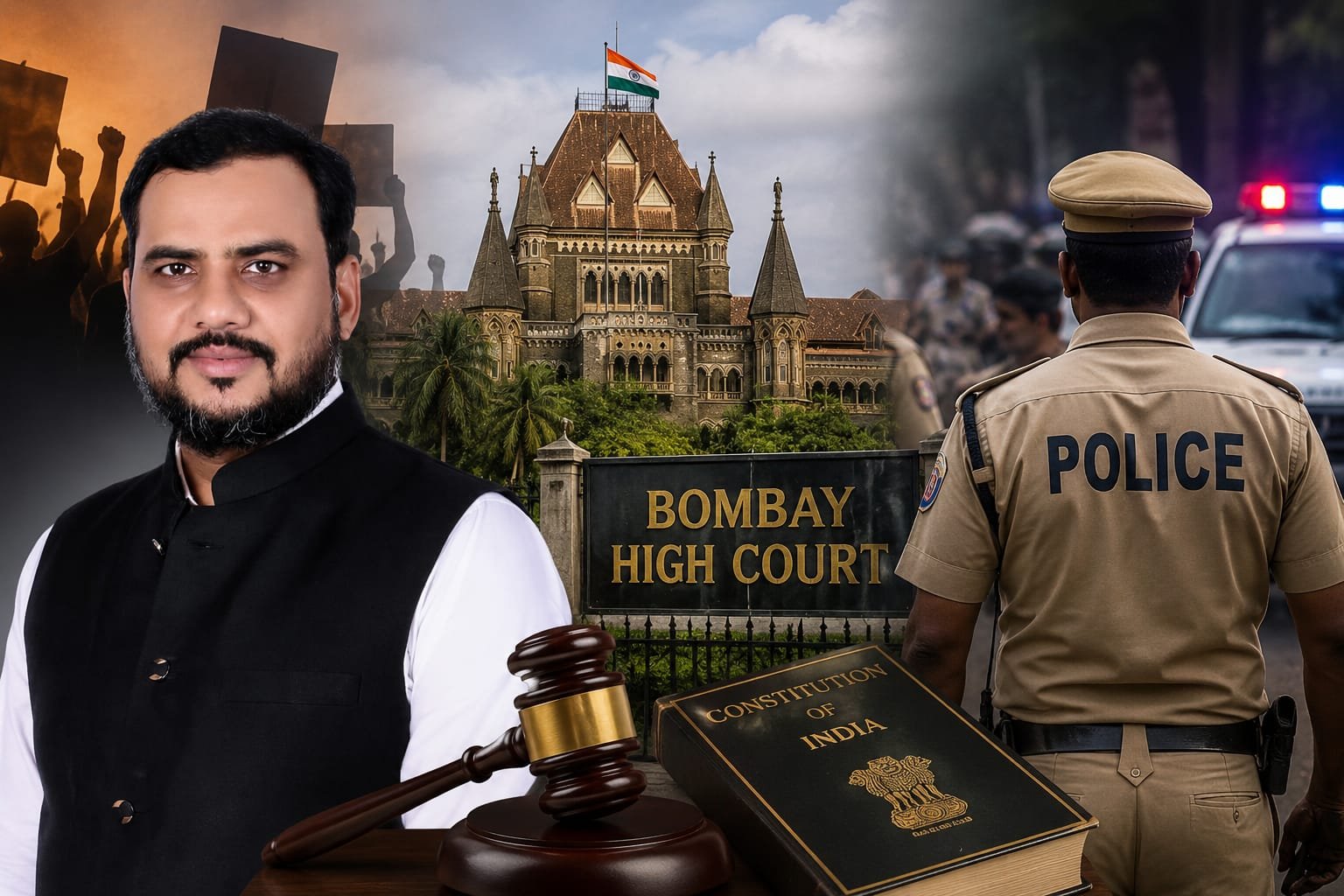
Emphasising that the right to dissent and engage in peaceful protest is a fundamental feature of the Constitution, the Bombay High Court, in a significant judgment delivered on Thursday, held that a citizen cannot be externed merely for opposing government policies, organising protests, or raising slogans against the government. The Court made it clear that such action violates the right to freedom of speech and expression under Article 19 of the Constitution, as well as the right to live with dignity under Article 21.
A single-judge Bench of Justice Madhav Jamdar set aside the one-year externment order issued against Saeed Ahmed Abdul Waheed Chaudhary, Maharashtra General Secretary of the Social Democratic Party of India (SDPI), observing that opposing government decisions cannot constitute a valid ground for externment under the Maharashtra Police Act.
Action Based on Five FIRs
According to the records placed before the Court, Saeed Ahmed Abdul Waheed Chaudhary had actively participated in marches and sit-in protests against the Citizenship (Amendment) Act (CAA), the Gyanvapi Mosque dispute, and other decisions of the Union Government. Citing five FIRs registered in connection with these protests, the Mumbai Police had externed him for one year on December 3, 2025. Subsequently, on March 27, 2026, the Divisional Commissioner of the Konkan Division upheld the externment order.
Hearing the petition challenging both orders, the High Court quashed the administrative action.
“Are Citizens Slaves of the Government of India?”
During the hearing, Justice Madhav Jamdar expressed strong displeasure over the approach adopted by the police administration and made several significant oral observations.
He remarked “What is happening? Are citizens being made slaves of the Government of India? Can they not protest? Can they not agitate? So many examination papers are being leaked. If people protest against that, will criminal cases be registered against them? The right to protest is a constitutional right of every citizen.”
The judge also noted that the petitioner had merely raised slogans such as “BJP Government Murdabad” and “Amit Shah Murdabad.”
He asked “Why can’t citizens raise such slogans? How can a person be externed merely for raising such slogans?”
“The Police Serve the People, Not the Government”
Commenting on the role of the police, Justice Jamdar observed “The police are not servants of the Chief Minister or the Prime Minister; they are servants of the people. If such action has been taken without adequate legal basis, heavy costs may also be imposed on the concerned officers.”
Written Order Refers to Constitutional Rights
In its written order, the Court observed that the petitioner had opposed certain decisions of the Union Government in his political and social capacity. It held that such opposition alone cannot justify a harsh measure like externment.
The Court further observed that the administrative action appeared, prima facie, to be mala fide and infringed the petitioner’s fundamental rights guaranteed under Articles 19 and 21 of the Constitution. It reiterated that every citizen has the right to express opinions, register peaceful dissent, and live with dignity.
Remarks on Politics
During the hearing, Justice Jamdar also made a satirical observation on the prevailing political situation in Maharashtra. He remarked that instead of discussing serious issues such as the death of a ten-year-old child in a road accident, the State Assembly was engaged in debates over political defections and power equations.
In a lighter vein, he said “Horse-trading is going on across Maharashtra. There are a few FIRs against you. You may also consider switching sides; there is a ‘washing machine’.”
However, this observation did not form part of the Court’s formal order and was made orally during the proceedings.
Reaffirmation of Democratic Values
The judgment is being viewed in legal circles as a reaffirmation of the constitutional principles of freedom of expression, the right to dissent, and democratic values. The ruling makes it clear that criticising the government or peacefully opposing its policies cannot be treated as a criminal act in a democratic system. If punitive action is taken against citizens solely because of their dissent, it would run contrary to the spirit of the Constitution and the fundamental rights guaranteed to every citizen.