
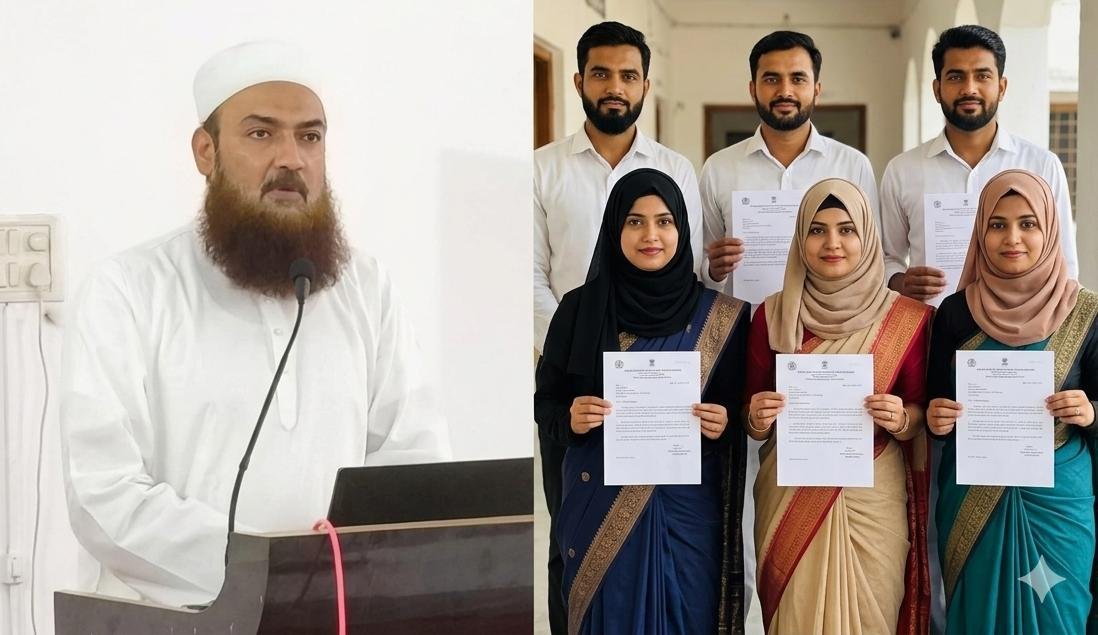
Amid preparations for the expansion of higher education in Bihar, a fresh debate has once again emerged over the Urdu subject. Objections have been raised after Urdu was not included in the teacher recruitment list for new government degree colleges proposed to be opened in 208 blocks across the state. In response, Imarat-e-Sharia has demanded that the Bihar government immediately revise the decision.
In a statement issued by the organization, Amir-e-Shariat Maulana Ahmad Wali Faisal Rahmani said that Urdu is the second official language of Bihar and is also included in the Eighth Schedule of the Constitution of India. Therefore, excluding it from the new higher education framework cannot be considered justified.
Nazim of Imarat-e-Sharia, Mufti Saeedurrahman Qasmi, has sent a formal letter to the Chief Minister and Education Minister requesting that the Higher Education Department’s circular dated April 30, 2026 (No. 364) be amended and Urdu be included as the 17th subject in the teacher recruitment list.
‘Right to equal opportunity’ cited as core issue
In its letter, Imarat-e-Sharia stated that the issue is not about any special privilege but about the fundamental right to equal opportunity. The organization argued that a large number of students in Bihar study Urdu and aspire to pursue higher education, research, and teaching careers. The absence of Urdu faculty in new colleges could limit opportunities, especially for students from rural and economically weaker backgrounds.
Reference to Constitution and education policy
The organization has cited Articles 14, 15, 29, and 350A of the Indian Constitution, stating that these provisions guarantee equality, prohibit discrimination, and protect the educational rights of linguistic minorities. It has also referred to the National Education Policy 2020, which promotes multilingualism and mother-tongue-based education.
‘Urdu is a shared cultural heritage’
Imarat-e-Sharia further stated that Urdu is not confined to any one religion or community but is part of India’s shared cultural, literary, and journalistic heritage. Bihar has historically contributed significantly to Urdu literature, journalism, and poetry, and excluding it from higher education would undermine this legacy.
Demand for immediate government action
The organization has made the following key demands:
Immediate review of the teacher recruitment subject list
Inclusion of Urdu as the 17th subject
Creation of Urdu teaching posts where required
Issuance of a revised circular
Inclusion of Urdu in all future education policies
Imarat-e-Sharia expressed hope that the Bihar government will take a sensitive view of the matter and take timely steps to address the concerns of Urdu-speaking students, teachers, and parents.