

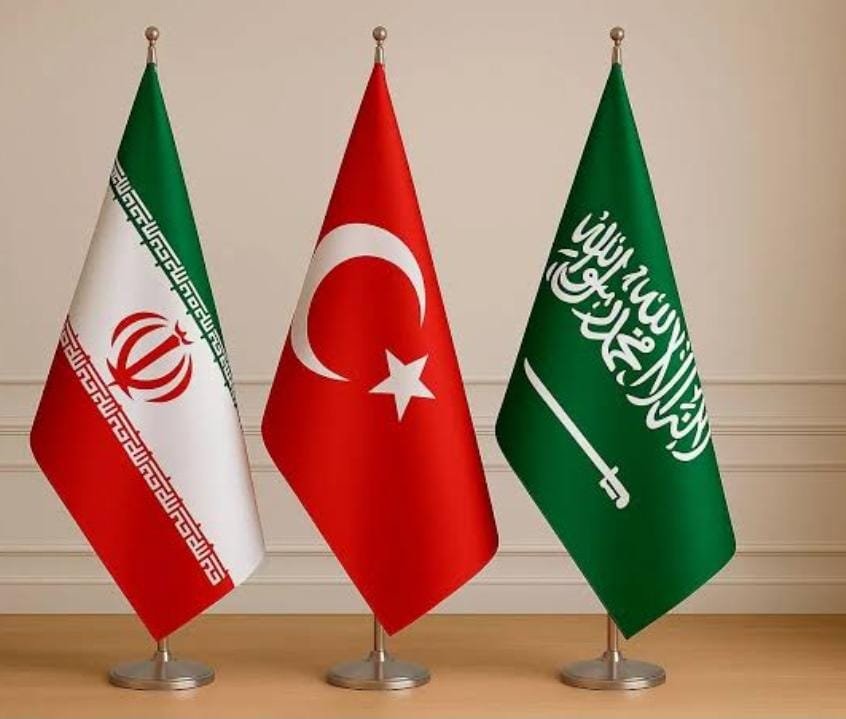
Amid the ongoing war between Iran, the United States, and Israel in the Middle East, diplomatic activity across the region has intensified. While Iran has welcomed Saudi Arabia’s position that its airspace, territorial waters, and land will not be used for military operations against Tehran, Türkiye has issued a warning to Washington and Tel Aviv over the escalating conflict and urged efforts to de-escalate tensions.
Iran’s Ambassador to Saudi Arabia, Alireza Enayati, told the news agency AFP that Tehran appreciates Riyadh’s assurance that its territory will not be used for any military action against the Islamic Republic of Iran. He said the Saudi leadership has repeatedly made it clear that its airspace and land will not be made available for attacks against Iran.
Enayati also revealed that prior to the outbreak of the war, Saudi Arabia had supported diplomatic efforts aimed at reducing tensions between Tehran and Washington and had tried to prevent a confrontation in the region.
Türkiye Voices Strong Concerns
Meanwhile, Türkiye’s Foreign Minister Hakan Fidan expressed serious concern over the growing military tensions in the Gulf region. He said Iran’s strategy of launching indiscriminate missile and drone attacks on Gulf countries is “a very wrong approach” that could further destabilize the region.
In an interview with the Turkish state broadcaster TRT Haber, Fidan noted that the Middle East has already endured numerous wars and crises over the past two decades, and the current conflict could push the region toward a wider war.
According to Fidan, the situation became extremely grave after the United States and Israel launched military operations against Iran on February 28. During the military campaign announced by US President Donald Trump, Iran’s Supreme Leader Ayatollah Ali Khamenei and several senior military officials were killed. In response, Tehran carried out drone and missile strikes targeting Israeli positions and several facilities across the Gulf region.
Risk of Regional Escalation
The Turkish foreign minister warned that if the war continues in its current form, its repercussions could extend across the region and the global economy. He cautioned that attacks on energy infrastructure could trigger severe instability in global energy markets, potentially leading to energy shortages and rising inflation in several regions, including Europe.
Fidan also warned that a further expansion of the war could trigger a large-scale refugee crisis, which would directly impact Türkiye and other neighboring countries.
Calls for Diplomatic Resolution
Türkiye has also signaled its willingness to play a mediating role in the crisis. Fidan said Ankara had engaged in talks with both the United States and Iran before the war began in an attempt to reduce tensions. He disclosed that he had met Iran’s Foreign Minister Abbas Araghchi in Istanbul to discuss possible solutions.
According to Fidan, if diplomatic initiatives had been pursued more seriously at that time, the war might have been avoided. He added that Türkiye is still working with regional and international partners to halt the conflict and explore possibilities for a ceasefire.
“Only the United States Can Restrain Israel”
Speaking about a potential ceasefire, the Turkish foreign minister said that under current circumstances, only the United States has the leverage to restrain Israel. He added that regional and European countries must clearly convey to Washington that the expansion of the war would ultimately cause the greatest damage to them.
Analysts believe Saudi Arabia’s neutral stance and Türkiye’s active diplomatic engagement indicate that regional powers are trying to prevent the conflict from turning into a wider regional war. However, with military operations continuing on the ground, the situation remains extremely volatile.