

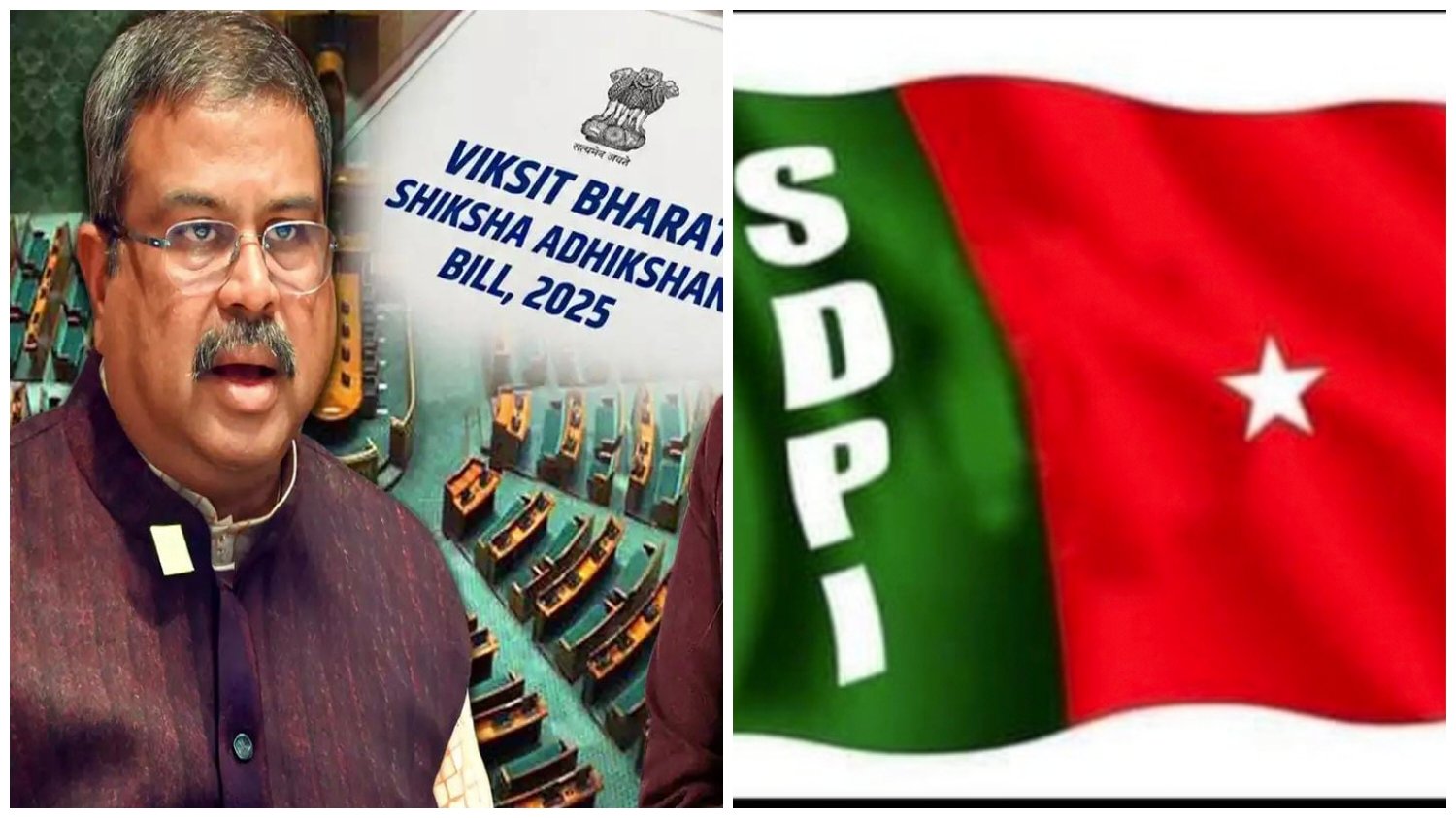
The Social Democratic Party of India (SDPI) has strongly opposed the Viksit Bharat Shiksha Adhishthan Bill, 2025, introduced in the Lok Sabha, describing it as a serious threat to India’s higher education system. The party alleged that the Bill would undermine academic freedom, erode states’ rights and weaken social inclusion by promoting excessive centralisation.
In a statement issued on Monday, SDPI said the Union government is projecting the Bill as a reform aligned with the National Education Policy (NEP) 2020, but its actual design dismantles the statutory and institutional framework that has governed higher education for decades.
The party raised particular concern over the proposal to repeal the University Grants Commission (UGC) Act, 1956, the All India Council for Technical Education (AICTE) Act, 1987, and the National Council for Teacher Education (NCTE) Act, 1993, and subsume all three bodies under a single central authority—the Viksit Bharat Shiksha Adhishthan.
SDPI national vice president Mohammed Shafi said replacing multiple statutory regulators with a single “super-regulator” is neither democratic nor accountable. He alleged that the move would concentrate academic decision-making in New Delhi and push states to the margins.
The party argued that higher education is not merely about maintaining standards, but is closely linked to language, regional needs, social context and equitable access. Imposing a uniform regulatory framework, it said, could damage India’s academic diversity.
SDPI also questioned the government’s proposed technology-driven “faceless regulation” model. According to the party, decisions taken through digital platforms would be difficult to challenge, particularly for students and teachers in rural areas, smaller institutions and marginalised communities.
Expressing concern over provisions granting greater autonomy to so-called “high-performing” institutions, SDPI warned that the Bill could widen inequalities within the sector. While elite institutions may benefit, public universities catering to Dalits, Adivasis, minorities and first-generation learners could face increased surveillance and chronic underfunding, it said.
The party further pointed out that despite claims of being student-centric, the Bill provides limited space for students’ representation in governance, while grievance-redressal mechanisms remain within the same regulatory structure, raising concerns about conflicts of interest.
Linking the Bill to a broader trend, SDPI accused the BJP-led Union government of systematically weakening autonomous institutions, including universities, through centralisation.
SDPI demanded that the Bill be withdrawn and referred to a Parliamentary Standing Committee, that states, teachers’ unions, students’ organisations and minority institutions be meaningfully consulted, and that existing statutory bodies be reformed rather than abolished.
India, the party said, does not need a centralised or corporatised education model, but a democratic, inclusive and federal higher education system that treats education as a public good.