

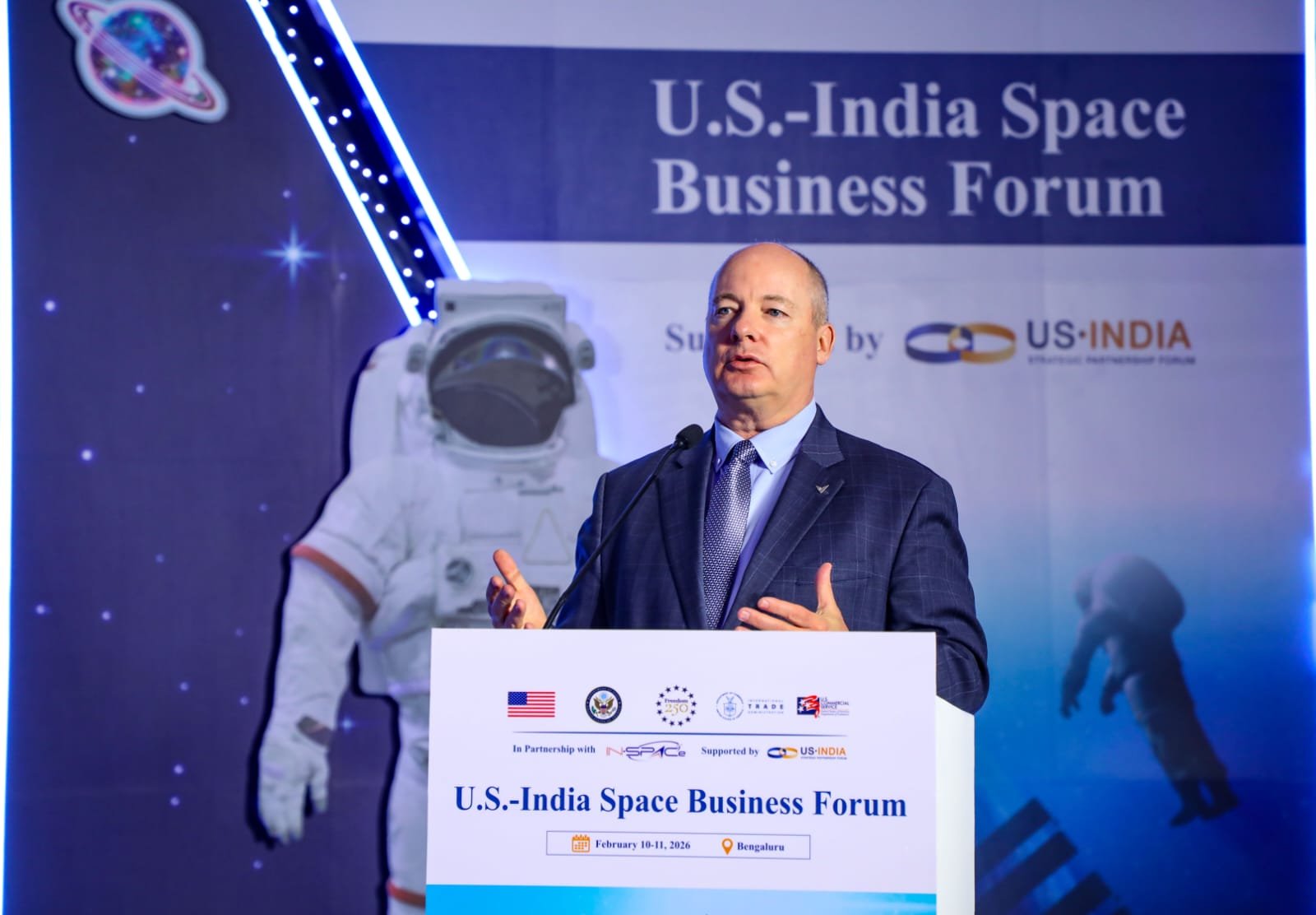
U.S. expert Eric Stallmer highlights how growing commercial collaboration can position the United States and India to shape the emerging low Earth orbit economy.
The space sector is fast becoming a driver of economic growth and strategic influence. For U.S. space industry expert Eric Stallmer, recent engagements in Bengaluru and New Delhi pointed to a clear opportunity: aligning India’s growing start-up base with lessons from the U.S. commercial model. “We had great conversations about what the American model has looked like and what Indian start-ups might take from that experience. Those discussions were really engaging and thoughtful,” he says.
Stallmer’s visit under the U.S. Speaker Program , which included the U.S.-India Space Business Forum and university roundtables, highlighted how commercial innovation, policy frameworks, and investment can come together to expand U.S.-India space collaboration.
Lessons from the U.S. model
In his conversations with Indian entrepreneurs and researchers, Stallmer saw strong interest in how the United States has built a commercially driven space sector, particularly in the factors enabling companies to scale.
He points to a fundamental shift in the U.S. approach as a driver of that growth. “The U.S. has gone through a real shift from a model where the government did almost everything to one where it relies heavily on the commercial sector,” he says.
A central part of this transition has been a regulatory approach that evolves alongside the industry. “The light-touch regulatory approach has been very helpful,” Stallmer explains. “The government reviewed what was already in place and asked what still made sense and what needed updating.”
This included adapting policies to address emerging needs, such as expanding frameworks beyond launch to areas like reentry. “Taking that kind of evolutionary approach to policy, keeping what works and adapting where needed, has helped foster the growth of the U.S. commercial space sector,” he notes.
For Indian companies, these lessons are particularly relevant as the country’s space sector expands rapidly. With a growing base of start-ups and increasing private-sector participation, the opportunity lies in pairing that momentum with enabling policies, access to capital, and global partnerships.
The next frontier of partnership
For Stallmer, the next phase of U.S.-India collaboration will be shaped by the rapid expansion of the low Earth orbit economy. “I am really excited about commercial space stations. I think that’s the next big step in the low Earth orbit economy,” he says. Stallmer points to Starlab , a next-generation commercial space station being developed by Voyager Technologies with NASA support, as an example. Designed as a state-of-the-art research facility in space, Starlab is expected to support a wide range of scientific and commercial activities. “I see a lot of opportunity there for scientists and researchers around the world, including in India,” Stallmer notes.
With growing demand for microgravity research, such platforms are opening new avenues for international participation. India’s plans to build a space station by 2035 further expand the scope for collaboration, creating opportunities for joint research, shared capabilities, and commercial partnerships.
Navigating markets, building partnerships
For Indian companies looking to enter the U.S. market, Stallmer emphasizes that success requires more than technical expertise. “You need a strong scientific and engineering mindset, but also real business skills,” he says. Founders must balance innovation with execution, including raising capital, writing proposals, and working closely with government partners. As companies scale, understanding how to operate in a highly competitive and fast-moving market becomes just as important as developing new technologies.
For Stallmer, sustained collaboration between government and industry will be key to advancing U.S.-India space ties. He points to joint efforts like the NISAR mission as a model for what is possible when both sides align on shared goals. “That kind of engagement can really drive growth for both American and Indian companies,” he says, emphasizing the value of deeper company-to-company collaboration, particularly among start-ups.
At the same time, platforms like the U.S.-India Space Business Forum are turning intent into action. By bringing together companies, investors, and government representatives, the forum created opportunities to exchange ideas, understand market needs, and build partnerships. “It created a space where you could meet a wide range of companies and learn about what they’re building and where the opportunities are,” Stallmer notes.
He also highlights the role of entities like the U.S. Department of Commerce and the U.S. Commercial Service in supporting these connections and helping companies navigate new markets. “Forums like this open dialogue and create real pathways for collaboration. A lot of partnerships start in settings like this,” he says.
Looking ahead, Stallmer sees strong momentum for U.S.-India cooperation in space, driven by shared capabilities and growing commercial interest. “I really believe global partnerships and global commerce are the future, and I look forward to our two countries working more closely together.”
Courtesy: SPAN