

Insaaf Times Desk
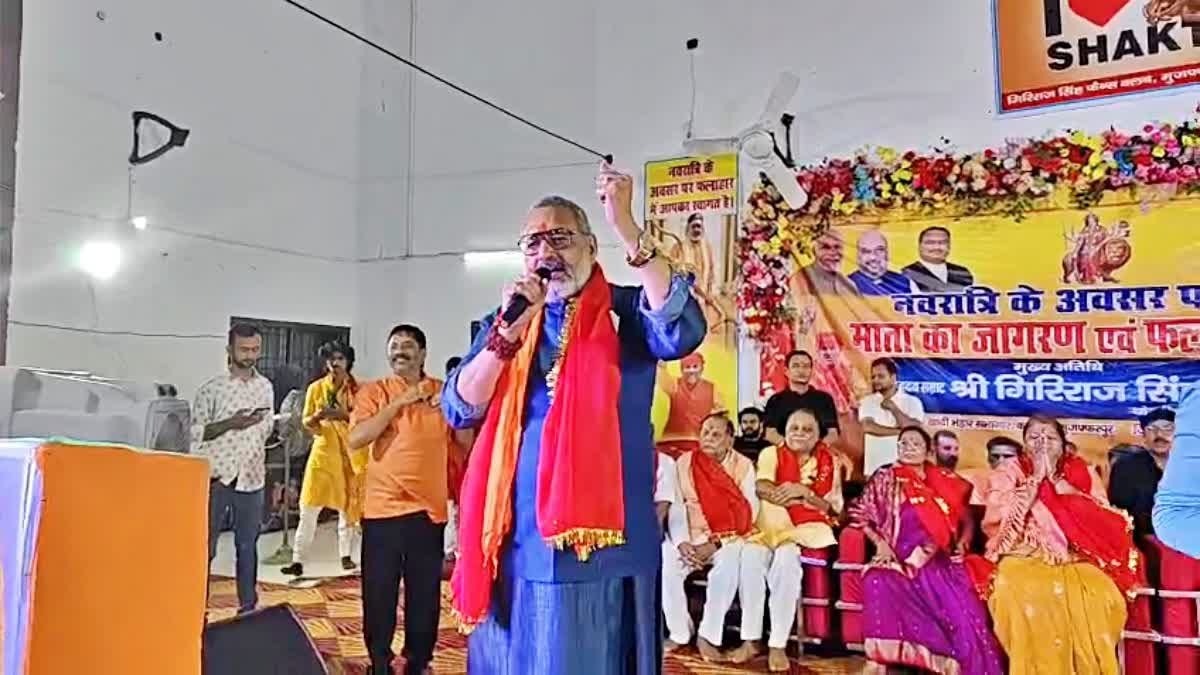
On the occasion of Navratri, Union Minister Giriraj Singh launched a scathing attack on West Bengal Chief Minister Mamata Banerjee during a falahaari (fruit-based fasting) program held in Muzaffarpur, Bihar, on Saturday. Addressing the gathering at the Khadi Bhandar auditorium, Singh compared Banerjee to Hussain Suhrawardy, the then Prime Minister of Bengal during 1946–47, accusing her of pursuing “anti-Hindu policies.”
The event began with Durga aarti and worship rituals. Singh was welcomed by party workers showering flowers from a bulldozer. He also distributed swords among the workers, calling on them to remain vigilant and strong for the protection of religion and culture.
“Mamata Banerjee is walking the path of Suhrawardy. Like the Direct Action Plan, her policies are anti-Hindu and are fueling communal tensions in Bengal,” Singh declared. He added, “One Jinnah divided India into Pakistan and Bangladesh, but today there are many Jinnahs present in the country.”
Referring to Hindu mythology, the Union Minister said that while devotees worship Lord Krishna in his playful form—stealing butter and playing the flute—they neglect his warrior form with the Sudarshan Chakra. “That neglect,” he claimed, “is the reason Krishna Janmabhoomi was taken over.”
In his interaction with the media, Singh targeted RJD leader Tejashwi Yadav, asserting that he could “never become the Chief Minister of Bihar.” Taking a jibe at Lalu Prasad Yadav, Singh remarked that the song “Dil ke armaan aansuon mein beh gaye” aptly described his political downfall.
He also criticized the Gandhi-Nehru family, saying that from Jawaharlal Nehru to Sonia, Rahul, and Priyanka Gandhi, they “did nothing for women.” In contrast, Singh praised Prime Minister Narendra Modi and Bihar Chief Minister Nitish Kumar for their women’s empowerment initiatives.
Highlighting the “Lakhpati Didi” scheme, Singh described it as a historic step. He claimed the program was not just worth ₹75,000 crore, but could potentially expand to ₹75 lakh crore. Urging workers to spread awareness about the scheme, he emphasized that it would help women become self-reliant and economically empowered.