

Insaaf Times Desk
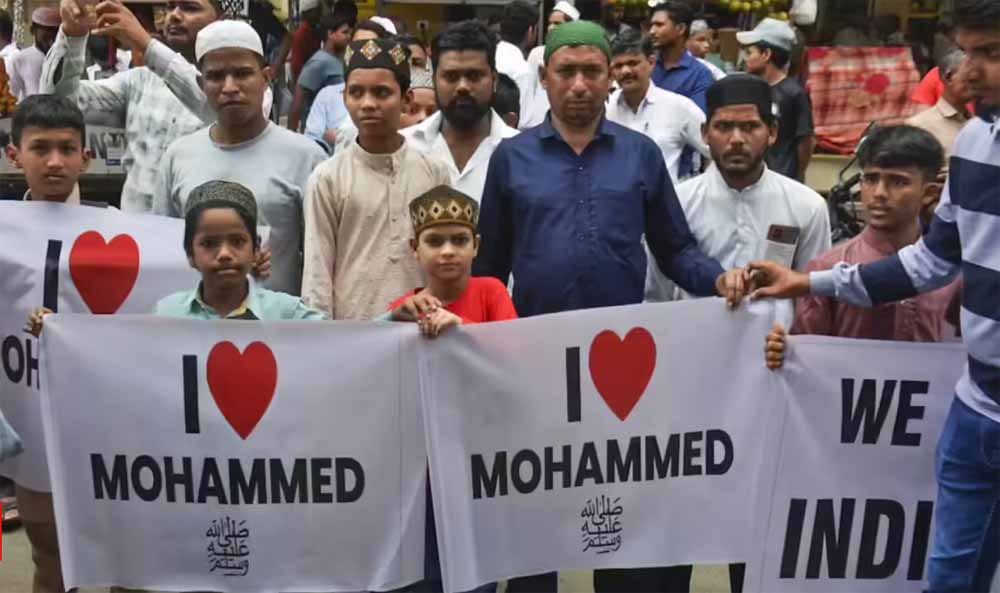
The Association for Protection of Civil Rights (APCR) has released its fact-finding report titled “A Fact-Finding Report into Collective Punishment and Criminalizing Faith: ‘I Love Muhammad’ Demonstrations in Bareilly.” The report highlights the protests held in Bareilly on September 26, 2025, and the subsequent police and administrative actions across India, calling them an example of “collective punishment and treating religious devotion as a criminal act.”
According to the report, the protests were organized in response to a controversial FIR filed in Kanpur. The FIR was related to a banner reading “I Love Muhammad” displayed during Eid-Milad-un-Nabi celebrations. Police alleged that the banner caused communal tension, but local residents told APCR that it had been installed with official permission. Following opposition from right-wing groups, police instead took action against the Muslim organizers.
Following the nationwide protests, around 4,500 people have been charged across India. In Bareilly, thousands of people gathered peacefully after Friday prayers under the leadership of Barelvi cleric and Ittehad-e-Millat Council (IMC) chief, Maulana Tauqeer Raza Khan. Authorities had denied permission for the demonstration, but the crowd remained peaceful.
The APCR report states that police used lathi-charge and force without prior warning. A local lawyer told the fact-finding team “Videos clearly show the crowd was calm, but police launched an attack without any warning.”
Within 48 hours, 10 FIRs were filed, naming over 2,000 people. By October 7, 89 Muslims had been arrested, including several minors. Many detainees were not informed of the charges or provided with copies of the FIRs.
The report also documents property seizures and demolitions following the protests. 32 shops in Pehalwaan Markaz Market were sealed without notice, and the Raza Palace banquet hall, owned by Maulana Tauqeer Raza’s close aide Dr. Nafees, was demolished under heavy police presence. Local residents described these actions as “punitive measures” following the protests.
APCR concluded that the administration’s actions were “aggressive and disproportionate,” violating civil rights, due process, and human rights. The report noted that while Muslim-majority areas faced heavy police surveillance, Hindu-majority neighborhoods remained unaffected.
The organization has called on the government to resume dialogue with the Muslim community, investigate police excesses, release those unlawfully detained, and take disciplinary action against responsible officials. The report stated “The government must stop treating expressions of faith as acts of rebellion. Peaceful devotion and love cannot be criminalized.”