

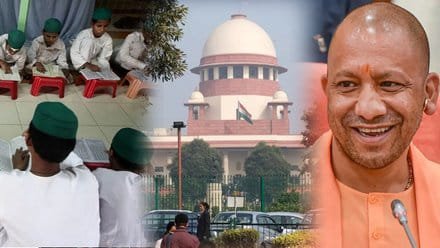
The Allahabad High Court has once again adopted a firm stance against administrative actions being taken against madrasas in Uttar Pradesh. The Lucknow Bench has categorically held that the absence of official recognition cannot, by itself, be a legal ground to shut down a madrasa. Terming the sealing of a madrasa in Shravasti district as prima facie arbitrary, the court directed that the lock be removed.
Justice Subhash Vidyarthi, in his order, directed that the seal placed on the madrasa be removed within 24 hours of the certified copy of the order being produced. The court also questioned the administration on the statutory provision under which such action had been taken.
The case pertains to Madrasa Ahle Sunnat Imam Ahmed Raza, which was ordered to be closed on 1 May 2025 by the District Minority Welfare Officer, Shravasti, on the ground that the madrasa was not officially recognised by the government.
Rejecting this reasoning, the High Court observed that the Uttar Pradesh Non-Government Arabic and Persian Madrasa Recognition, Administration and Service Regulations, 2016 do not contain any provision authorising the closure of a madrasa merely because it is unrecognised.
The court clarified that under the rules, the sole consequence of non-recognition is that the concerned madrasa is not entitled to receive government grants. It remarked that the administration had sought to convert provisions relating to financial aid into a power of closure, which is legally impermissible.
Appearing for the madrasa, advocate Syed Farooq Ahmed informed the court that his client neither receives nor seeks any form of government assistance.
He argued that “when a madrasa does not seek any government grant, the question of shutting it down solely on the ground of non-recognition does not arise. The administration has acted beyond the scope of its authority.”
The counsel further submitted that Regulation 13 does not confer any such power on the District Minority Welfare Officer.
During the hearing, the state government was represented by Additional Chief Standing Counsel Devendra Mohan Shukla, while no representative appeared on behalf of the Uttar Pradesh Madrasa Education Board.
The High Court has sought a response from the state government and indicated that it would undertake a detailed examination of the legal validity and constitutional limits of administrative actions being taken against madrasas.
Legal experts believe that this order could serve as an important precedent in cases where recognition is being used as a pretext for coercive action against educational institutions.
The matter goes beyond a single madrasa and raises a broader question: can the executive, through a misinterpretation of rules, curtail the rights of minority educational institutions?
The Allahabad High Court’s position makes it clear that any action taken in disregard of law and constitutional principles will not withstand judicial scrutiny.