

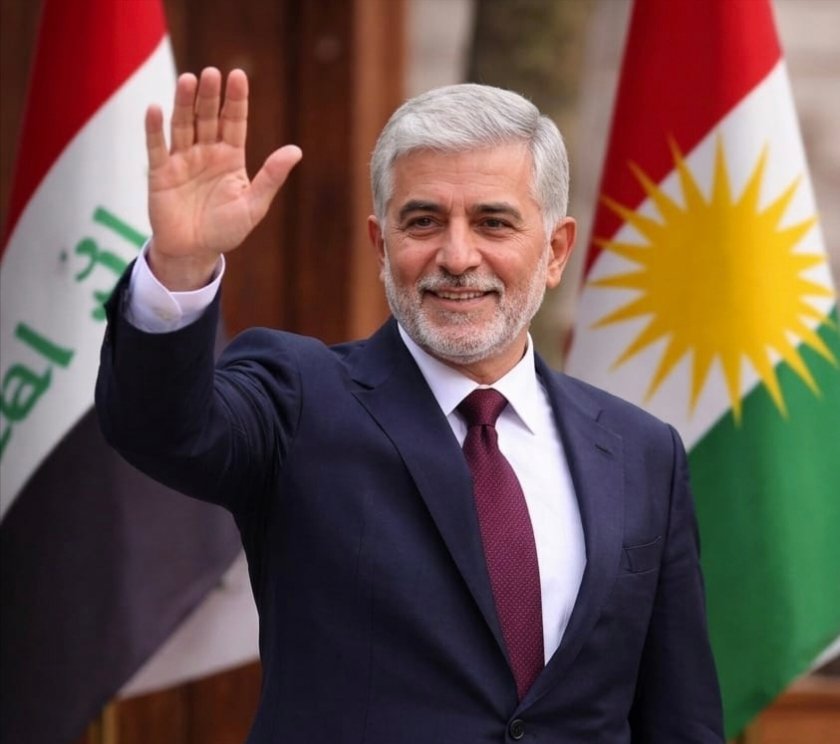
The long-standing political deadlock in Iraq has finally come to an end. The country’s parliament has elected Kurdish leader Nizar Amedi as the new President of Iraq in a decisive vote. The development comes at a time when the country had been facing political uncertainty for nearly five months without a fully formed government.
In the second round of voting held under strict security arrangements in the capital Baghdad, Nizar Amedi secured 227 votes, while his rival managed only 15 votes. The result is being seen as a clear parliamentary majority and a significant shift in Iraq’s political balance.
Kurdish Leadership Returns and Power Balance
Nizar Amedi’s election as President is being viewed as a strong comeback of the Kurdish community within Iraq’s complex power-sharing system.
After the fall of Saddam Hussein in 2003, Iraq’s political structure was designed to distribute top positions among major communities—President for the Kurds, Prime Minister for Shiite parties, and Speaker of Parliament for Sunnis. The aim was to maintain balance among different groups, but over time, this system also became a source of political competition and deadlock.
PUK Support as a Decisive Factor
Amedi’s candidacy was supported by the Patriotic Union of Kurdistan (PUK), which proved to be a decisive factor in this election.
Kurdish politics has long been divided into two major factions, making it difficult to reach a consensus on the presidency. The PUK’s agreement on Amedi’s name is being seen as an important step toward political unity.
This support helped secure a clear majority in parliament and moved forward the long-stalled electoral process.
Electoral Delays and Political Deadlock
According to the Iraqi Constitution, the President must be elected within 30 days of the first parliamentary session. However, due to deep political disagreements, the process was delayed for several months.
Internal divisions within Kurdish factions, disputes within the Shiite alliance over power-sharing, and competition over the Prime Minister’s post had brought government formation to a standstill.
As a result, Iraq remained without a fully functioning government for nearly 150 days.
Regional Tensions and Security Challenges
Iraq is currently going through a period of widespread regional instability. In recent months, military tensions involving Iran, the United States, and Israel have affected the overall security situation across the Middle East.
Inside the country as well, tensions between Iran-backed armed groups and foreign military bases have further complicated the political environment.
International Pressure and Political Signals
US political leadership, including then-President Donald Trump, had taken a firm stance regarding Iraq’s political process. Continuous international pressure was applied over delayed and disputed nominations.
This pressure pushed Iraqi political parties toward compromise.
Next Step: Selection of the Prime Minister
After the presidential election, the next crucial and sensitive phase in Iraq is the selection of the Prime Minister.
According to constitutional procedure, the President must invite the largest parliamentary bloc to form a government within 15 days, followed by the formation of a cabinet within 30 days.
However, the real political challenge begins here, as the issue of the Prime Minister’s post brings back complex power-sharing dynamics among Shiite, Sunni, and Kurdish groups.
Nizar Amedi’s election as President marks an important turning point in Iraqi politics, ending a prolonged period of deadlock. It is seen as a revival of Kurdish political influence and the beginning of a new power balance.
However, the country’s real test is still ahead, where the selection of the Prime Minister will determine whether Iraq moves toward stability or slips back into another political crisis.