

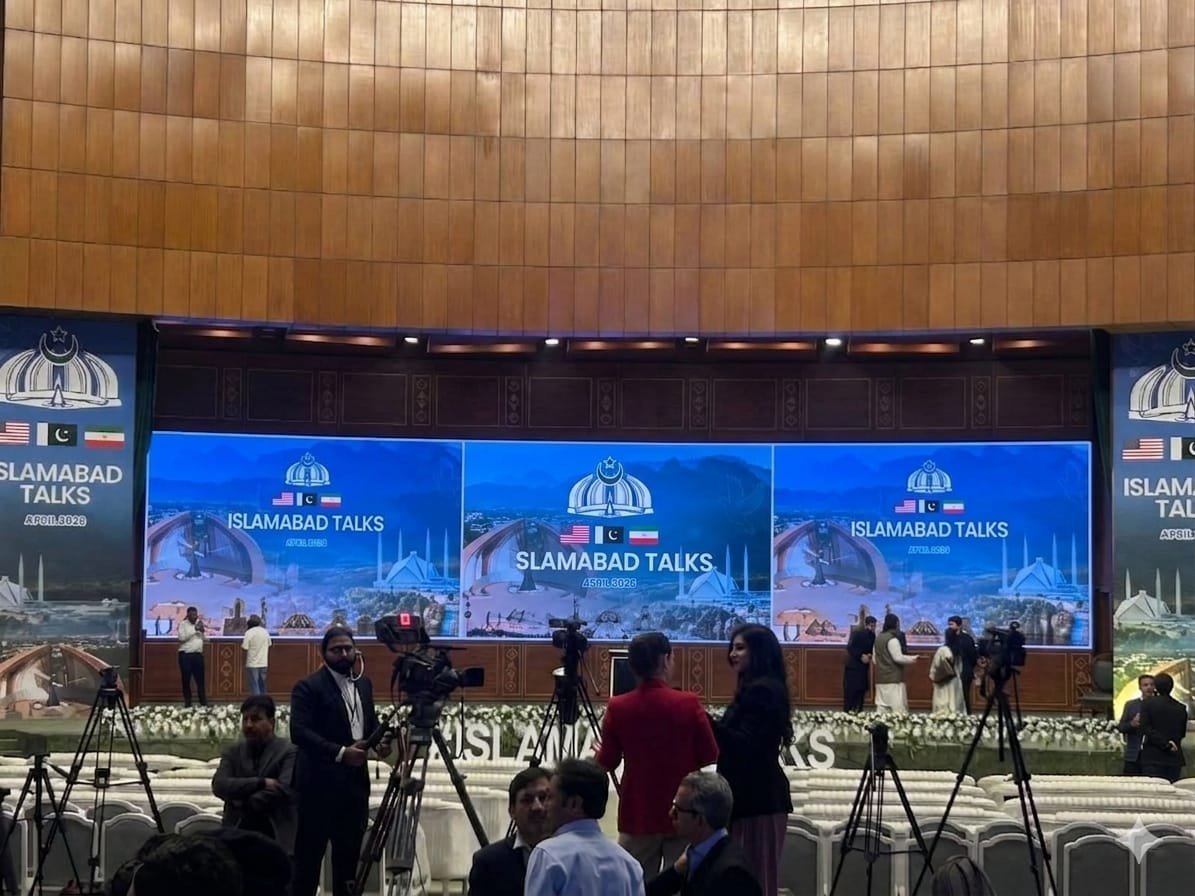
Amid ongoing tensions in the Middle East, long-anticipated peace talks between United States and Iran have begun in Islamabad, the capital of Pakistan. However, early developments indicate that the negotiations are at a highly complex and sensitive stage. Deep mistrust between the two nations, strict conditions, and sharp rhetoric have made the process even more difficult.
According to sources, the talks are not being held directly but are progressing through indirect channels. Instead of sitting face-to-face, both sides are exchanging messages and questions through mediators. This is the same method previously adopted in Oman and Geneva.
To move the negotiations forward, Iran has presented four clear and firm conditions. The most significant demand is full and unconditional control over the Strait of Hormuz. Additionally, Iran has demanded compensation from the United States for past attacks. The third condition calls for the immediate restoration of $120 million in assets frozen under sanctions. The fourth and most comprehensive demand is the implementation of a simultaneous ceasefire across the Middle East, including conflict zones such as Gaza, Lebanon, Yemen, and Iraq.
Strong signals have also emerged from the U.S. side. Vice President JD Vance stated that the United States wants to move the talks forward, but the final decision lies with Iran. Meanwhile, President Donald Trump questioned Iran’s intentions, saying it is difficult to reach an agreement with a party that cannot be trusted. He also warned that if no agreement is reached, the United States would not hesitate to consider military options.
The focal point of this crisis has become the Strait of Hormuz, one of the world’s most critical oil routes. Under current conditions, maritime traffic through the strait has nearly come to a halt. Reports suggest that hundreds of ships, including a large number of oil tankers, are stranded in the region. Iran has established a “safe corridor,” allowing only limited vessels to pass, significantly impacting global energy supply.
Meanwhile, diplomatic activity has intensified in Islamabad. The U.S. delegation is being led by Vice President JD Vance, accompanied by senior officials such as Steve Witkoff and Jared Kushner. On the Iranian side, the delegation is headed by Parliament Speaker Mohammad Bagher Ghalibaf. Both sides have also held separate meetings with Pakistan’s Prime Minister Shehbaz Sharif.
The Iranian delegation consists of around 70 members, including experts in technical, economic, security, and media fields—indicating that Tehran is taking the negotiations very seriously. However, Iranian leadership has made it clear that they do not trust the United States. Ghalibaf stated that Iran is ready to engage in talks with “goodwill,” but any agreement would require the U.S. to recognize Iran’s rights.
Accusations and counter-accusations between the two countries have also intensified. Donald Trump has accused Iran of spreading “fake news” and using maritime routes as leverage, while Iran has described the talks as an effort to end an “illegal war.”
The world’s attention is now firmly focused on Islamabad. Since the Iranian Revolution, this is considered one of the highest-level engagements between the United States and Iran. The talks, being mediated by Pakistan, could prove decisive not only for regional peace but also for the future of global energy markets and international politics.
For now, the negotiations are ongoing, but the situation suggests that reaching a final resolution will not be easy.