

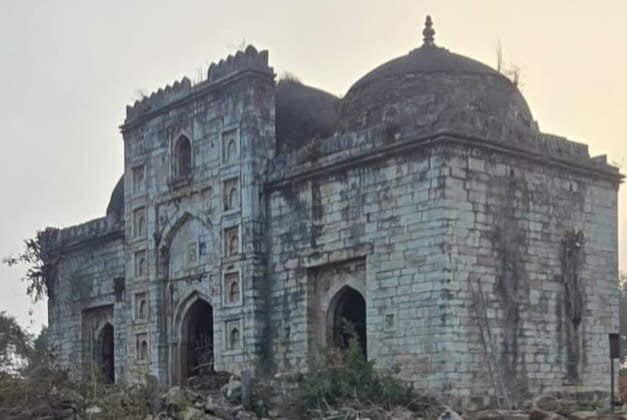
An approximately 500-year-old Mughal-era mosque located inside the historic Rohtasgarh Fort in Bihar’s Rohtas district, nestled in the Kaimur hills, has once again come into public focus. Situated near the Ghazi Gate, the three-domed mosque was constructed in 986 Hijri (1578 CE) during the reign of Mughal emperor Akbar by Habsh Khan. Ravaged by time and long neglect, the fragile monument has now become the centre of a remarkable grassroots initiative that stands as a powerful example of communal harmony in today’s polarised times.
On Monday, residents from Rohtasgarh and nearby areas—belonging to both Hindu and Muslim communities—came together to clean the overgrown bushes and accumulated filth around the mosque. More than five dozen people participated in the voluntary labour drive. The initiative was led by social activist Krishna Singh Yadav, Torab Niyazi, representative of the chief councillor of Rohtas Nagar Panchayat, and Archaeology Department official Amrit Jha. Participants said the effort was not merely about saving a structure, but about sending a message that humanity rises above religious divisions.
Historians note that the mosque is among the earliest Mughal-era structures built in Bihar. Renowned historian Professor Qiyamuddin Ahmad has mentioned the mosque in his book Corpus of Arabic & Persian Inscriptions of Bihar. The inscription on the mosque itself bears the name of Emperor Akbar. According to the inscription, Rohtasgarh Fort came under Mughal control in 1576, when the Mughal general Shahbaz Khan Kamboh took over the fort following the surrender of its commander, Syed Muhammad. The mosque was constructed two years later, in 1578.
Habsh Khan is also mentioned in the Akbarnama, where he is described as a loyal Mughal officer during the Afghan rebellion in Bihar. Historians believe that a domed tomb located a short distance west of the mosque once belonged to Habsh Khan, though it has now almost completely disappeared. Scholars and social activists fear that the mosque could meet a similar fate if timely conservation measures are not undertaken.
During the cleanliness drive, Archaeology Department official Amrit Jha said, “I am proud of the example set by people from both communities working together. It is truly memorable. The remaining work will be completed by the department, and the monument will be properly monitored.”
Local residents also raised questions about the Bihar government and the Archaeological Survey of India (ASI). They pointed out that while the government speaks of promoting tourism, historic monuments such as this mosque continue to suffer from neglect. The community has demanded a permanent conservation plan for the Rohtasgarh mosque so that future generations can witness and learn from this shared heritage.
At a time when headlines are often dominated by stories of hatred and division, the initiative at Rohtasgarh serves as a reminder that history lives not only in stone, but in the collective efforts of people determined to protect their shared past.