

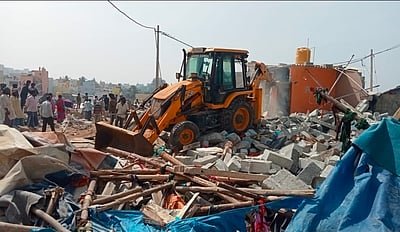
In the early hours of Saturday, the administration launched a large-scale anti-encroachment drive in Bengaluru’s Kogilu village, demolishing Fakir Colony and Waseem Layout using bulldozers. Nearly 400 houses were razed, leaving around 3,000 people, including women, elderly, and children, homeless.
According to Maktoob Media’s on-ground reporting, the operation began around 4 a.m. with a heavy police presence, as officials from the Greater Bengaluru Authority (GBA) deployed four JCB machines to flatten the structures. Authorities cleared LPG cylinders and other flammable items from inside the houses before demolishing them.
Residents alleged that they had been living in the area for 20 to 30 years and possessed all necessary documents, including Aadhaar cards, voter ID cards, PAN cards, and ration cards. Despite this, they were neither given any written notice nor provided with rehabilitation or compensation.
An elderly woman said she was not given time to remove her belongings. “Our children were outside, and I was alone. The bulldozers came and destroyed everything,” she told reporters.
In conversations with Maktoob Media, locals rejected the administration’s claims, stating that they have lived there for decades and regularly benefited from government schemes. GBA officials, however, argued that the colony had been illegally established on land near the Urdu Government School pond, without any construction permits.
Residents also said that they had been facing continuous pressure to vacate over the past few years, and electricity and internet services were cut off a day before the demolition.
According to Maktoob Media’s ground report, over 500 children from the area study in government and private schools. The sudden demolition has thrown their education and future into serious uncertainty.
Around 150 police personnel, including senior officers, were deployed at the site during the operation. However, the residents allege that no government officials or representatives have provided relief or alternative arrangements so far.
By evening, the devastated community sat among the rubble of their homes, holding identification documents as proof of their existence, while their future remained deeply uncertain.