

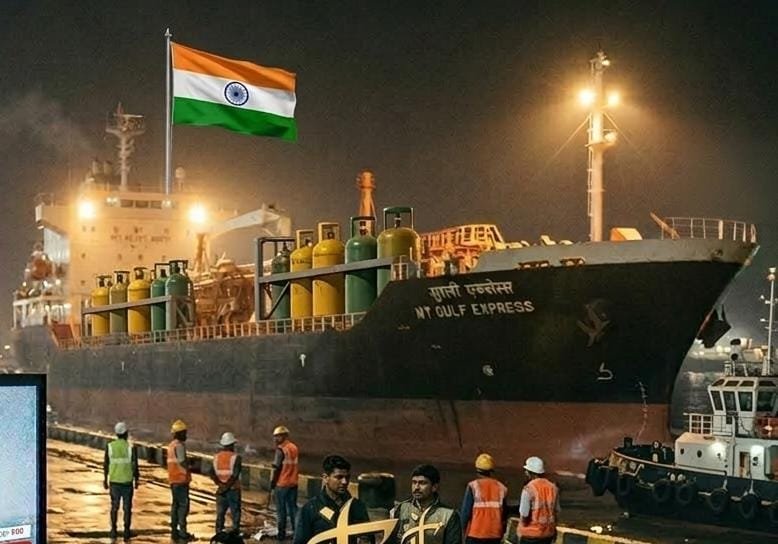
Amid rising military tensions and maritime insecurity in West Asia, India is facing both relief and concern. On one hand, Iran has granted special permission for two Indian LPG tankers to pass through the strategically vital Strait of Hormuz. On the other hand, the broader crisis has raised serious concerns about billions of dollars in remittances from the Gulf region and the stability of India’s energy supplies.
India’s External Affairs Minister Subrahmanyam Jaishankar held multiple rounds of discussions with Iran’s Foreign Minister Abbas Araghchi. In addition, Prime Minister Narendra Modi spoke over the phone with Iranian President Masoud Pezeshkian. Following these diplomatic engagements, Iran allowed two Indian ships to safely pass through the strait and proceed toward India.
Special Permission for Two Indian LPG Tankers
According to reports, two Indian LPG tankers—Shivalik and Nanda Devi—have been granted permission to cross the Strait of Hormuz and sail toward India. One of the vessels has already safely passed through the strategic maritime route, while the other is following behind.
Both ships are considered crucial for India’s energy supply as they are carrying LPG intended for domestic consumption. After the recent escalation in regional tensions, Iran significantly tightened surveillance across the maritime corridor, disrupting ship movements.
A Critical Route for Global Energy Supply
The Strait of Hormuz is widely regarded as one of the world’s most important energy transit routes. Around 20 percent of global oil and gas supplies pass through this narrow waterway.
Any disruption in this strait can affect not only regional trade but also global energy markets, often leading to volatility in oil and gas prices worldwide.
24–26 Indian Ships Still Stranded
Although the clearance for two ships offers temporary relief for India, the situation remains far from normal. Sources indicate that around 26 Indian vessels are still stranded in the region. These include tankers carrying LPG, crude oil, and other essential cargo.
The Indian government is continuing diplomatic efforts with regional countries to ensure the safe passage of these ships and restore normal maritime movement.
$50 Billion Remittances from the Gulf at Risk
The crisis could affect more than just energy supplies. According to a report by Al Jazeera, escalating tensions involving the United States, Israel, and Iran could threaten the livelihoods of millions of Indian workers in Gulf countries and the massive remittances they send back home.
India is the world’s largest recipient of remittances, receiving more than $100 billion annually from overseas workers. Nearly half of this—around $50 billion—comes from Gulf countries such as United Arab Emirates, Saudi Arabia, Qatar, Kuwait, and Oman.
An estimated 9–10 million Indians work in these countries, many of them employed in construction, oil and gas, services, and transportation sectors. These workers send billions of dollars to their families each year, providing crucial financial support to households across India.
Dual Challenge for India
Experts warn that if the West Asia conflict drags on, the Gulf economies could come under pressure. This may slow down construction and energy projects, potentially reducing demand for foreign workers and affecting the income of Indian expatriates.
As a result, India could face a dual challenge: disruptions to energy supplies and maritime trade on one side, and a possible decline in remittances from Gulf-based workers on the other.
While Iran’s decision to allow two Indian LPG tankers to pass through the Strait of Hormuz offers short-term relief, the ongoing tensions in West Asia highlight how sensitive the region is for India’s energy security, maritime trade, and billions of dollars in remittance inflows.
Experts believe that unless regional tensions ease soon, the crisis could impact not only global oil and gas supplies but also the livelihoods of millions of Indian families and the country’s foreign exchange stability.