

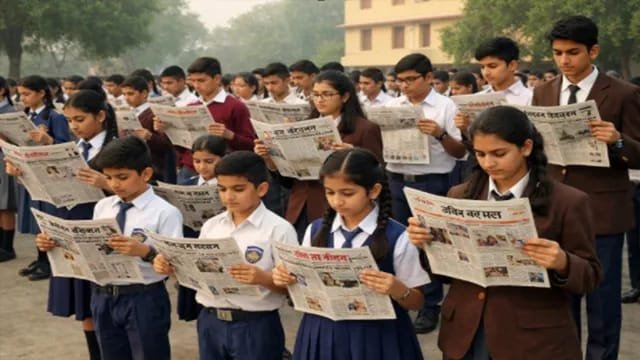
The Uttar Pradesh government has made newspaper reading mandatory for students in all government-run basic and secondary schools across the state. Under the new initiative, schools will now allocate 10 minutes every day during the morning prayer assembly for news reading. The government said the move aims to develop reading habits among students, reduce dependence on digital screens, and enhance general knowledge.
In this regard, an order was issued on December 23, 2025, by Additional Chief Secretary (Basic and Secondary Education) Parth Sarathi Sen Sharma. The directive clearly states that printed newspapers in both Hindi and English must be regularly made available in schools and that students should be encouraged to read them.
According to the order, students will read out important and positive news related to national, international, sports, and social issues on a rotational basis during the morning assembly. Selected excerpts from editorial articles will also be read aloud to help develop critical thinking and logical understanding among students.
The Education Department believes that the increasing use of mobile phones and other digital devices is affecting students’ concentration. In such a scenario, reading physical newspapers will not only help reduce screen time but also promote a culture of reading.
Government officials said that regular newspaper reading would strengthen students’ general knowledge and awareness of current affairs, which would be beneficial for future competitive examinations. It is also expected to improve language skills and writing abilities.
The order also mentions puzzles published in newspapers, such as Sudoku, crosswords, and word games, stating that these activities help develop logical reasoning and problem-solving skills. In addition, news related to social and human-interest issues is expected to foster sensitivity and social awareness among students.
Although the directive currently applies only to government schools, the Education Department said that private and other educational institutions may also adopt the practice if they find it beneficial.
Education experts said that if implemented effectively, the initiative could play a significant role in connecting students with society and contemporary issues beyond textbooks and the formal curriculum.